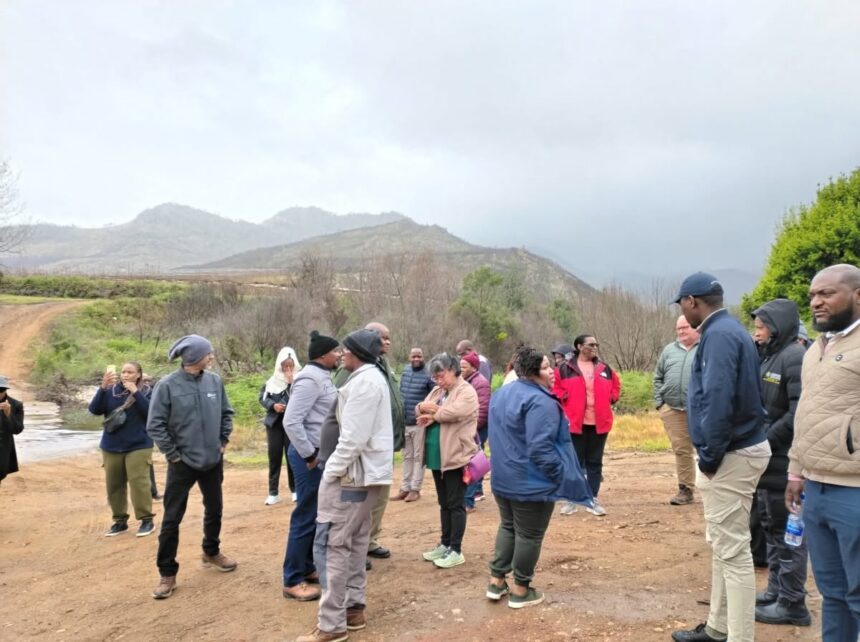
The National Agrometeorological Committee has continued its engagement with farmers affected by recent floods in the Eastern Cape, with the second day of its programme focusing on the Koukamma Local Municipality. Committee members visited Hankey and Joubertina in the Sarah Baartman District Municipality to assess the impact of the flooding on agricultural activities and engage directly with affected farmers. The visits provided an opportunity to understand the damage from the perspective of producers who are dealing with the consequences on the ground. Discussions also focused on what farmers need to restore their production and livelihoods after the floods. The engagement forms part of efforts to identify practical interventions that can support agricultural recovery in affected areas.
Flooding can have significant consequences for farming operations, particularly when agricultural land, infrastructure and production resources are damaged. Farmers can face losses when crops are affected, agricultural infrastructure is damaged or access to farms is disrupted. The effects can continue after floodwaters recede because farmers may need to repair facilities, restore fields and replace damaged production resources before normal activities can resume. For livestock farmers, flooding can also create challenges related to access, animal management and the condition of grazing areas. Understanding the full extent of these impacts is therefore important when determining the type of assistance that affected producers may require.
The visits to Hankey and Joubertina allowed committee members and other stakeholders to engage directly with farmers rather than relying only on reports about the damage. Direct engagement gives producers an opportunity to explain what happened on their farms and identify the challenges that are preventing them from returning to normal production. Farmers can also provide information about the specific infrastructure, equipment or agricultural resources that have been affected. This information can help government officials develop a clearer understanding of the conditions facing farming communities. It also allows proposed interventions to take account of the practical circumstances of individual producers and the wider agricultural area.
The Koukamma Local Municipality forms part of the Sarah Baartman District Municipality, where agriculture contributes to rural economic activity and local livelihoods. When agricultural production is disrupted by extreme weather events, the impact can extend beyond individual farms. Farmers depend on surrounding infrastructure, transport networks, markets and service providers to maintain their operations and move agricultural products. Damage to these systems can create additional challenges even after farms themselves have been assessed. This makes coordinated support important when communities are recovering from a major weather-related event.
The National Agrometeorological Committee’s involvement is particularly relevant because weather and climate conditions can have a direct influence on agricultural production. Agrometeorological information can help stakeholders understand the relationship between weather events and agricultural impacts. Assessing the consequences of flooding can also contribute to better planning for future weather-related risks. Farmers need timely information and appropriate support when extreme weather affects their production cycles. Combining information about weather conditions with direct reports from farmers can provide a stronger basis for planning agricultural responses.
The discussions during the site visits focused on possible interventions and mechanisms through which the National Department of Agriculture could assist affected farmers. This is important because different forms of flood damage may require different types of support. Some farmers may need assistance to restore productive capacity while others may require help with damaged infrastructure or other agricultural resources. Identifying these needs can help ensure that support is directed towards the areas where it can contribute to recovery. A clear assessment of damage is therefore an important step before interventions can be properly planned and implemented.
Restoring agricultural production is important not only for farmers but also for local food supply and rural economies. When producers are unable to farm, the effects can be felt through reduced production, lost income and disruptions within agricultural value chains. Farmers also need to meet ongoing household and business costs even when their ability to generate income has been affected by a disaster. Timely support can help reduce the period during which a farming enterprise remains unable to operate normally. Recovery measures that help farmers return to production can therefore contribute to wider economic stability in affected communities.
The engagement also highlights the importance of preparing farmers and agricultural systems for future extreme weather events. Flooding cannot always be prevented, but farmers and authorities can work towards reducing the potential impact of severe weather. This can include better information, appropriate infrastructure, risk management and agricultural planning. Understanding what happened during recent floods can provide useful lessons for future preparedness. Information gathered during assessments can help identify vulnerabilities that may need to be addressed before another major weather event occurs.
For farmers in flood-affected areas, direct communication with government officials can also provide an opportunity to explain the challenges that may not be immediately visible from outside the farm. Production losses are not always limited to what can be seen in damaged fields or buildings. Farmers may also face difficulties accessing markets, obtaining inputs, repairing equipment and maintaining normal operations. These challenges can affect the pace at which an agricultural enterprise recovers. Continued engagement after the initial assessment can therefore be important to ensure that identified needs are followed through with appropriate support.
The second day of the National Agrometeorological Committee’s engagement programme in Hankey and Joubertina has brought attention to the immediate needs of farmers affected by flooding in Koukamma Municipality. The site visits allowed stakeholders to assess agricultural damage, listen directly to producers and discuss possible mechanisms for government assistance. For affected farmers, restoring production will require practical support that addresses the specific challenges created by the floods. The information gathered during these engagements can help inform decisions about recovery interventions and future preparedness. Continued coordination between farmers, government departments and other stakeholders will be important as the affected agricultural communities work towards restoring their livelihoods and strengthening their resilience to future weather events.
Join 'Farmers Mag' WhatsApp Channel
Get the latest Farming news and tips delivered straight to your WhatsApp
CLICK HERE TO JOIN