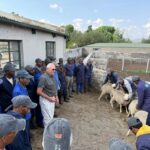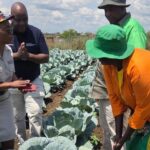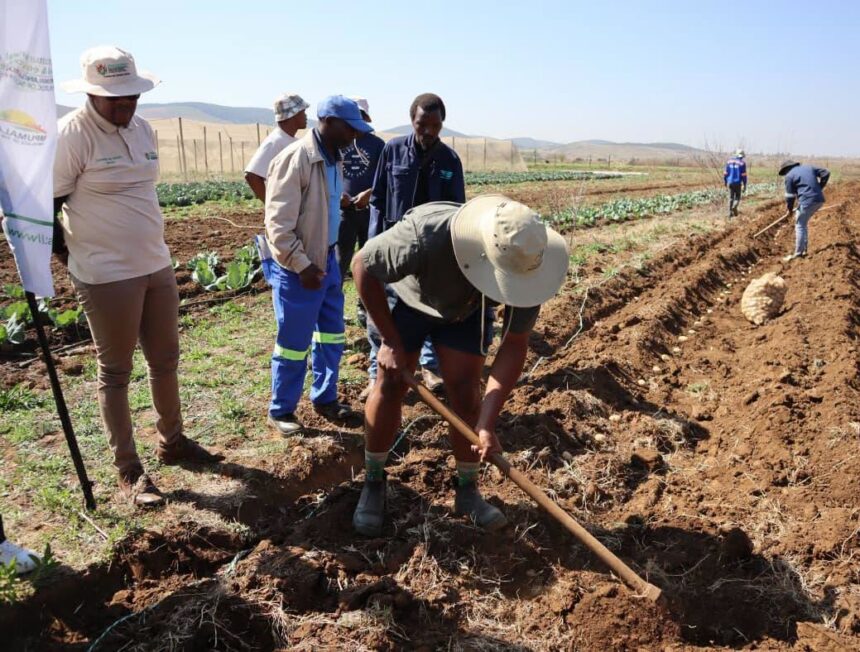
The Mpumalanga Department of Agriculture, Rural Development, Environment and Land Administration (DARDLEA) has partnered with Potatoes SA to give farmers in Amsterdam, under Mkhondo Local Municipality, practical training in potato production. The hands-on workshop focused on improving farmers’ knowledge of planting techniques, crop management and sustainable production practices. As part of the initiative, potatoes were planted at the Women Power Agricultural Co-operative and the Intandeko Agricultural Co-operative. The programme provides local farmers with an opportunity to gain practical experience that can be applied directly to their own fields. It also highlights the importance of collaboration between government, agricultural organisations and farming communities in strengthening local food production.
The Mondial potato cultivar was planted at both agricultural projects during the workshop. Introducing a specific cultivar under local conditions gives farmers and agricultural specialists an opportunity to assess how the crop performs in the area. Farmers were provided with important information on precision planting techniques, including soil separation, planting depth and the correct spacing between plants. These factors can have a direct impact on crop establishment, plant development and eventual yields. By combining practical demonstrations with technical information, the workshop aimed to ensure that farmers understand not only what to do but also why each production practice matters.
Soil preparation and separation were among the important areas covered during the practical session. Proper soil management can help create suitable conditions for potato development and improve the efficiency of planting operations. Farmers also received guidance on optimal planting depth, which is important because planting too shallow or too deep can affect crop establishment and development. Correct spacing was another key consideration because plants need enough room to access water, nutrients and sunlight while maintaining efficient use of available land. The practical approach allowed farmers to see these techniques being applied directly in their fields rather than relying only on theoretical explanations.
The workshop also placed strong emphasis on Integrated Pest Management as part of responsible potato production. Integrated Pest Management involves combining monitoring, prevention and appropriate control measures to manage pests while reducing unnecessary reliance on chemical interventions. Farmers were introduced to the importance of identifying potential pest and disease problems at an early stage. This approach can help producers respond before infestations become difficult and costly to manage. Building this knowledge at the production level can contribute to healthier crops and more sustainable farming practices.
Crop rotation was highlighted as another important sustainable practice during the workshop. Rotating crops can help disrupt pest and disease cycles by preventing the repeated planting of the same crop in the same soil. This can reduce the conditions that allow certain pests and diseases to become established and spread from one season to another. For small-scale and emerging farmers, effective crop rotation can form part of a broader strategy to protect soil health and improve long-term productivity. Farmers can therefore use production planning not only to manage their current crop but also to prepare their fields for future seasons.
Early warning monitoring was also identified as an important part of potato crop management. Farmers were encouraged to remain alert for signs of blight and aphid infestations, which can threaten potato production if they are not identified and managed promptly. Regular monitoring allows farmers to detect changes in their crops and seek technical advice when problems emerge. Early detection can also help farmers make informed decisions about the appropriate response instead of waiting until damage becomes widespread. This proactive approach supports better crop management and can help reduce potential production losses.
The performance of the Mondial cultivar in Amsterdam will be closely monitored throughout the production cycle. Monitoring the crop under local conditions will provide useful information about its growth, development and productivity in the area. The results will be communicated to local farmers after harvesting, giving them practical evidence that can support future decisions about cultivar selection. This process is particularly important because crop performance can vary depending on soil conditions, climate, management practices and other local factors. The information gathered from the demonstration could therefore help farmers make more informed choices when planning future potato production.
The partnership between DARDLEA and Potatoes SA demonstrates the value of bringing technical expertise directly to farming communities. Farmers benefit when agricultural training combines professional guidance with practical demonstrations that reflect the conditions they face in their own fields. The workshop also creates an opportunity for farmers to ask questions, observe planting methods and better understand how different production decisions can influence results. Such engagements can strengthen farmers’ confidence while improving their ability to manage crops throughout the production cycle. Continued collaboration of this nature can contribute to stronger agricultural knowledge and better production outcomes in rural communities.
The planting activities at the Women Power and Intandeko Agricultural Co-operatives also have broader significance for local food production. Supporting agricultural co-operatives with practical knowledge can help communities use available land more effectively and develop sustainable production systems. Potato farming can provide farmers with an additional crop option while contributing to the availability of food within local communities. However, successful production requires careful planning, appropriate crop management and continuous monitoring. The workshop therefore focused on building practical capacity rather than simply introducing farmers to a new crop.
For farmers in Amsterdam, the demonstration provides an opportunity to learn from the performance of a potato cultivar under their own local conditions. The lessons from planting depth, spacing, soil management, pest monitoring and crop rotation can be applied beyond the demonstration plots. Farmers can also use the results from the Mondial cultivar to assess whether its production characteristics are suitable for their future farming plans. The value of the initiative will become clearer as the crop develops and the final harvest results are recorded. Sharing those findings with the wider farming community will help ensure that the knowledge generated through the project benefits more producers.
The initiative also reinforces the importance of sustainable agricultural practices as farmers face increasing pressure to produce food efficiently while protecting natural resources. Practices such as crop rotation, early pest detection and Integrated Pest Management can help farmers manage production risks while maintaining healthier farming systems. Practical training gives farmers the opportunity to understand how these measures work and how they can be incorporated into everyday farm management. Partnerships between agricultural authorities and industry organisations can further strengthen access to technical knowledge and support. This combination of practical skills, monitoring and collaboration can help build more resilient farming enterprises.
The potato planting workshop in Amsterdam is therefore more than a single planting exercise, as it creates a foundation for continued learning and evidence-based farming decisions. Through the partnership between Mpumalanga DARDLEA and Potatoes SA, farmers at the Women Power and Intandeko Agricultural Co-operatives received hands-on guidance that can support their potato production efforts. The monitoring of the Mondial cultivar will provide additional information about its performance under local conditions, while the lessons on precision planting, pest management and crop rotation can support sustainable production. As the crop progresses towards harvest, farmers will have an opportunity to see the impact of the practices demonstrated during the workshop. The results and lessons from the project could ultimately contribute to improved potato production, stronger farmer knowledge and greater agricultural development in the Amsterdam area.
Join 'Farmers Mag' WhatsApp Channel
Get the latest Farming news and tips delivered straight to your WhatsApp
CLICK HERE TO JOIN