

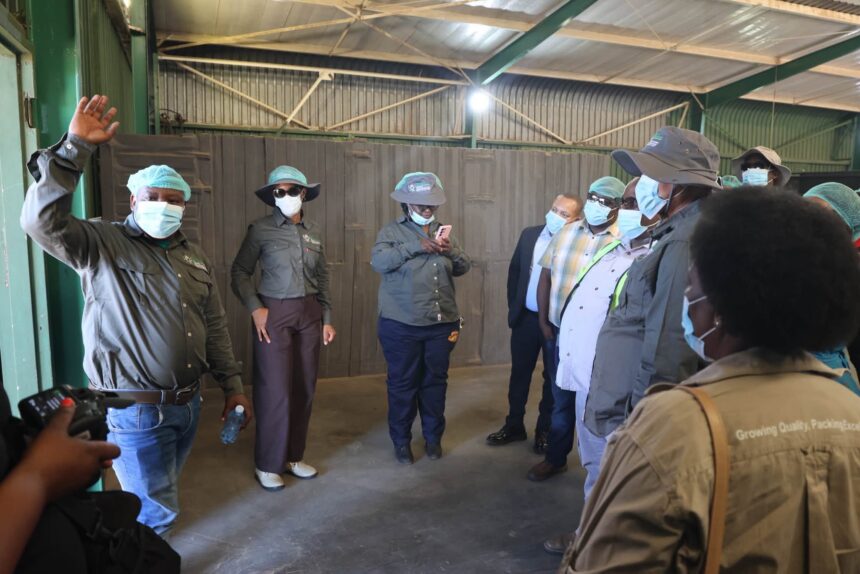
The launch of the Jantjies Boerdery Lucerne Packhouse in Taung marks an important development in efforts to strengthen agricultural value addition and rural economic activity in the North West. North West MEC Madoda Sambatha, accompanied by Deputy Minister for Agriculture Nokuzola Capa and senior government and community representatives, officially launched the facility as part of a programme focused on practical opportunities for farmers. The occasion also included the official launch of the Hemp Hub at Taung Agricultural College, creating a support platform for hemp producers. Together, the initiatives place agro-processing, farmer-led enterprises, skills development and market access at the centre of agricultural development in Taung. The developments provide a practical example of how agricultural production can be connected with processing, enterprise development and broader rural economic opportunities.
The official launch brought together representatives from different levels of government and public institutions. Those accompanying MEC Madoda Sambatha included Deputy Minister for Agriculture Nokuzola Capa, Head of Department Ms Lebo Diale, Local Economic Development MMC from the Dr Ruth Segomotsi Mompati District Municipality Solly Matobo and Gaolatlhe Kgabo, a Member of Parliament serving on the Portfolio Committee on Higher Education and the Portfolio Committee on Sports, Arts and Culture. Members of the North West Provincial Legislature also participated in the occasion. Their involvement highlighted the importance placed on agricultural development and economic activity in rural communities. The gathering also provided an opportunity to showcase initiatives designed to support farmers and strengthen participation in agricultural value chains.
The Jantjies Boerdery Lucerne Packhouse is central to the focus on agro-processing at the Taung launch. A packhouse can form an important link between agricultural production and the market by supporting the handling and preparation of agricultural products. In the case of lucerne, processing and packing activities can help connect primary production with downstream users and markets. The launch therefore represents more than the opening of an agricultural facility because it demonstrates the potential for farmer-led enterprises to participate in value addition. Developing this type of infrastructure can form part of a broader effort to increase the economic activity generated from agricultural production within rural areas.
Lucerne is widely used as a forage crop, particularly in livestock production, and its value extends beyond cultivation in the field. Once harvested, lucerne can be handled, processed and prepared for different uses depending on the requirements of the market. A packhouse provides a setting where agricultural products can move through additional stages before reaching customers or other businesses. This creates a connection between farming and agro-processing, which is an important part of developing agricultural value chains. For farmers and rural entrepreneurs, greater participation in these stages can provide opportunities to build businesses around both production and value-added activities.
The Hemp Hub at Taung Agricultural College adds another dimension to the agricultural development programme. The hub is intended to provide support to hemp producers through permit applications, training and skills development, market access and other support services. These services address several areas that can be important for farmers entering or expanding their participation in hemp production. Hemp production also operates within regulatory requirements, making access to information about permits and compliance particularly relevant for producers. By bringing different forms of support together, the Hemp Hub provides a structured platform for producers seeking assistance with the practical aspects of developing hemp-related agricultural activities.
Training and skills development form an important part of the Hemp Hub’s role. Agricultural producers need technical knowledge to understand production practices, manage their operations and respond to challenges during the farming process. Skills development can also support farmers who want to develop their enterprises beyond primary production and participate in related parts of the value chain. Market access support is another important element because agricultural production needs to connect with buyers and viable commercial opportunities. The combination of training, regulatory assistance and market-related support gives hemp producers access to several areas of assistance within a single initiative.
The focus on farmer-led enterprises is also significant for rural development. When farmers participate in agricultural businesses as producers and entrepreneurs, economic activity can extend beyond the farm itself. Agricultural enterprises can create demand for services related to transport, processing, packaging, equipment, maintenance and other business activities. The exact economic impact of an individual enterprise depends on its scale, performance, market conditions and ability to operate sustainably. However, supporting farmer-led businesses can contribute to a broader agricultural ecosystem in which rural producers have opportunities to participate in different stages of the value chain.
Agro-processing remains closely connected to the objective of increasing value within the agricultural sector. Selling an unprocessed agricultural product is only one way of participating in a value chain, while processing, packaging and related activities can create additional business functions. The Jantjies Boerdery Lucerne Packhouse demonstrates the importance of infrastructure that supports these activities in a rural setting. Such facilities can also help create opportunities for knowledge transfer and the development of skills related to agricultural handling and processing. For Taung, the initiative brings attention to the potential of agriculture as a foundation for wider economic development.
The launch of the Hemp Hub at Taung Agricultural College also strengthens the role of agricultural education and practical support. Agricultural colleges can provide environments where producers access knowledge and skills that can be applied to farming operations. Linking education and farmer support can help producers better understand production requirements while developing the capacity needed to manage agricultural enterprises. In the case of hemp, support with permits and other requirements can also help producers understand the regulatory framework governing the sector. This combination of education, compliance support and commercial assistance can help farmers make informed decisions about their operations.
Rural development depends on more than agricultural production alone. It also involves creating conditions where rural businesses can develop, farmers can access support and local economic activity can expand. The Taung initiatives bring these elements together by focusing on agro-processing through the lucerne packhouse and producer support through the Hemp Hub. They also demonstrate how government departments, educational institutions, local government and agricultural enterprises can participate in a shared development programme. The launch therefore places agriculture within a wider discussion about enterprise development, skills and economic participation in rural communities.
The initiatives also highlight the importance of market access for agricultural producers. Farmers can increase production only when they have realistic opportunities to sell their products and recover their costs. Market access support can help producers understand potential buyers, product requirements and commercial opportunities, although individual farmers still need to assess the financial and operational risks associated with their chosen enterprises. For both lucerne and hemp, the development of reliable value chains requires coordination between producers, processors, service providers and markets. Building these connections is therefore an important part of strengthening agriculture in Taung and across the North West.
The involvement of senior provincial and national agricultural representatives further demonstrates the policy importance of supporting rural agricultural enterprises. MEC Madoda Sambatha and Deputy Minister Nokuzola Capa participated in an occasion that focused on tangible agricultural infrastructure and producer support rather than production alone. The presence of Ms Lebo Diale, Solly Matobo, Gaolatlhe Kgabo and Members of the North West Provincial Legislature also reflected the participation of different institutions in the event. Their involvement provided a platform to showcase agricultural initiatives that seek to connect farmers with infrastructure, skills and economic opportunities. Continued implementation and support will determine how these initiatives develop and how effectively participating farmers can use the available facilities and services.
The launch of the Jantjies Boerdery Lucerne Packhouse and the Hemp Hub at Taung Agricultural College represents a focused effort to strengthen agricultural value chains in a rural area. The lucerne packhouse places agro-processing and farmer-led enterprise development at the centre of agricultural activity, while the Hemp Hub provides producers with support covering permits, training, skills development and market access. Together, the initiatives demonstrate the importance of combining production with infrastructure, knowledge, regulatory support and commercial opportunities. Their development also reinforces the role of agriculture in broader rural economic development across the North West. For Taung, the initiatives create a platform for continued engagement around value addition, farmer support and the development of sustainable agricultural enterprises.
Join 'Farmers Mag' WhatsApp Channel
Get the latest Farming news and tips delivered straight to your WhatsApp
CLICK HERE TO JOIN




