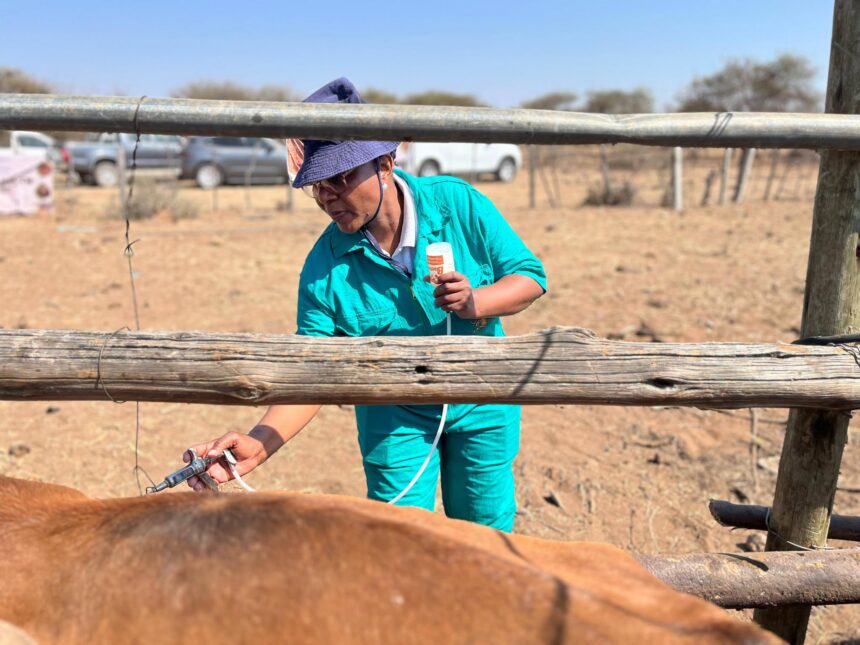
The Department of Agriculture and Rural Development is intensifying efforts to curb the spread of Foot and Mouth Disease (FMD) as vaccination campaigns continue reaching livestock owners across the province. The latest intervention took place among farmers from Marobala CPA in Senwabarwana, within the Capricorn East Agro-Ecological Zone, where livestock were brought forward for vaccination as part of ongoing animal health measures. More than 500 livestock belonging to members of the communal property association are expected to receive FMD vaccinations during the campaign. The animals will also be dipped to control external parasites, an intervention that is particularly relevant as the rainy season approaches. The continued rollout demonstrates the department’s focus on improving livestock protection through vaccination, parasite control, disease surveillance and cooperation with farmers.
Foot and Mouth Disease remains a serious livestock health concern because its spread can disrupt farming activities and create restrictions on the movement and marketing of animals. Controlling the disease requires coordinated action because livestock are managed across communal areas, CPAs, commercial farms and other agricultural enterprises. Vaccination forms an important part of the response, but its effectiveness depends on achieving broad coverage among animals in affected and at-risk areas. Farmers also need to cooperate with veterinary teams by making their livestock available when vaccination campaigns are conducted. The participation of Marobala CPA members therefore contributes to a wider provincial effort to strengthen protection across different farming communities.
The vaccination campaign at Marobala CPA is expected to reach more than 500 livestock, providing protection while also creating an opportunity for veterinary officials to carry out parasite control. External parasites can affect animal health and productivity, making regular dipping an important component of livestock management. The timing of the intervention is also significant because the approach of the rainy season can create conditions that influence parasite populations. Combining FMD vaccination with dipping allows farmers and veterinary officials to address more than one animal health concern during the same field operation. Such integrated interventions can help farmers maintain healthier livestock while supporting broader disease prevention efforts.
Progress in the Capricorn District shows the scale of the vaccination programme already implemented in the area. More than 90% of livestock have been reached through vaccination efforts involving communal farmers, CPAs, commercial farmers and other farming enterprises. Reaching such a high proportion of livestock provides an important foundation for strengthening disease control across the district. It also demonstrates the contribution made by farmers who have cooperated with veterinary services and presented their animals for vaccination. Maintaining and improving this coverage will remain important as authorities work to reduce opportunities for FMD to spread between livestock populations.
Despite the progress, approximately 10% of livestock in the Capricorn District have not yet been reached through vaccination efforts. State Veterinarian Dr Ramaselela Ngoako identified several factors contributing to the remaining gap, including farmers who do not make their animals available for vaccination. Poor conditions at animal-handling facilities can also make it more difficult for veterinary teams to carry out vaccination safely and efficiently. Limited cooperation from a small number of farmers presents another challenge because disease control depends on participation across the livestock sector. Closing the remaining vaccination gap will require continued engagement with farmers and practical efforts to address the obstacles preventing animals from being presented for vaccination.
Animal-handling facilities play an important role in vaccination campaigns because veterinary teams need suitable spaces to safely gather, restrain and manage livestock. Poorly maintained facilities can slow down operations and make the process more difficult for both farmers and animal health professionals. Improving these facilities could therefore support more efficient vaccination campaigns while strengthening broader livestock management practices. Farmers and communities can also benefit from understanding what improvements are needed to make handling areas safer and more functional. Investment in suitable infrastructure should form part of longer-term efforts to improve the province’s capacity to respond to livestock diseases.
The reported FMD suspicions in some parts of the Capricorn District further underline the importance of maintaining disease surveillance and vaccination efforts. Suspected cases require appropriate veterinary assessment and monitoring to determine whether further action is necessary. Farmers can support surveillance by observing their animals closely and reporting unusual signs or suspected infections to veterinary authorities without delay. Early reporting gives veterinary teams an opportunity to investigate concerns and implement relevant disease-control measures. Continued surveillance is particularly important when disease risks remain present, even when vaccination coverage has reached a high level.
The department’s approach relies heavily on collaboration between veterinary services and farming communities. Veterinary officials provide technical expertise, coordinate vaccination programmes and advise farmers on appropriate disease-control measures. Farmers, in turn, play a critical role by making their animals available for vaccination, following veterinary guidance and reporting suspected cases. This relationship becomes even more important in communal farming areas where livestock from different owners may share grazing and water resources. Strong cooperation can help veterinary services reach more animals and improve the consistency of disease-control measures across communities.
The involvement of communal farmers, CPAs and commercial producers in the Capricorn vaccination programme reflects the need for an inclusive approach to livestock disease management. FMD does not respect administrative boundaries or differences between farming systems, which means disease control requires attention across all livestock production environments. Gaps in vaccination coverage can create additional challenges for efforts to protect animals in surrounding areas. Ensuring that different categories of livestock owners participate in vaccination programmes can strengthen the overall level of protection. The more comprehensively the district reaches its livestock population, the stronger its ability to manage the risk of further transmission.
As the rainy season approaches, farmers also have an opportunity to strengthen broader livestock health practices alongside FMD prevention. Regular monitoring of animals, appropriate parasite control and good farm management can contribute to healthier herds. Farmers should also remain attentive to official veterinary guidance regarding livestock movements and disease-control measures in their areas. Maintaining accurate livestock information can further assist veterinary officials when they conduct surveillance and vaccination activities. These routine practices can complement vaccination and help farmers respond more effectively to animal health risks.
The latest vaccination campaign at Marobala CPA demonstrates the continued effort to protect livestock in the Capricorn East Agro-Ecological Zone and across the wider Capricorn District. With more than 90% of livestock already reached, the district has made substantial progress, but the remaining animals still need to be brought into the vaccination programme. Addressing challenges such as farmer participation and inadequate animal-handling facilities will be essential to closing this gap. Continued collaboration between the Department of Agriculture and Rural Development, veterinary services and farmers can strengthen vaccination coverage, disease surveillance and overall livestock health. As FMD suspicions remain under monitoring in parts of the district, sustained cooperation and responsible livestock management will remain critical to protecting the province’s herds and reducing the risk of further disease spread.
Join 'Farmers Mag' WhatsApp Channel
Get the latest Farming news and tips delivered straight to your WhatsApp
CLICK HERE TO JOIN