

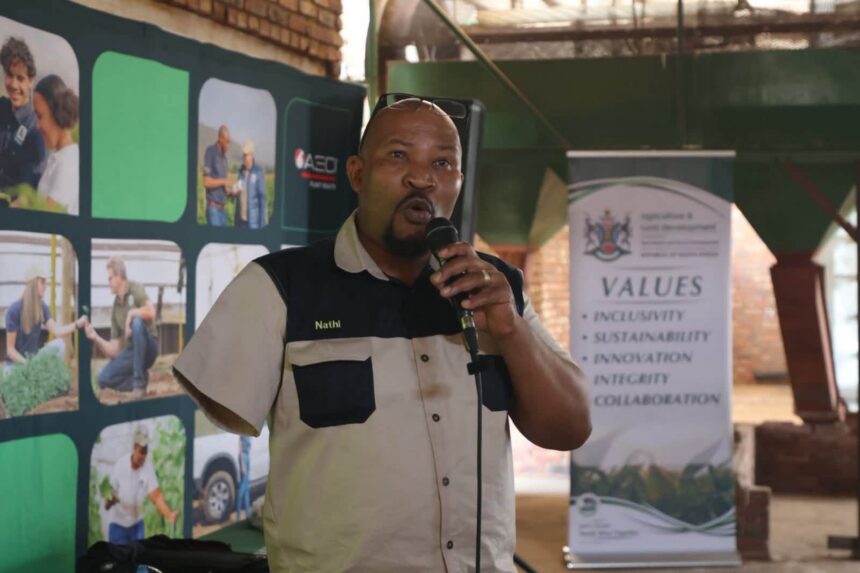
The Dr Kenneth Kaunda District Farmers Day brought farmers, agricultural stakeholders and industry representatives together to discuss practical issues shaping the future of sustainable and productive farming. The event provided a platform for farmers to gain knowledge about modern agricultural practices while addressing challenges that affect productivity, profitability and long-term sustainability. Discussions focused on regenerative agriculture, soil health, livestock farming, agricultural compliance, finance and the use of drone technology. These areas are increasingly important as farmers manage changing production conditions, rising input costs and the need to protect natural resources. By bringing technical knowledge and agricultural stakeholders together, the Farmers Day supported efforts to strengthen farming practices and improve the resilience of the agricultural sector.
Regenerative agriculture was one of the key focus areas at the Dr Kenneth Kaunda District Farmers Day. This approach places emphasis on improving soil, protecting natural resources and maintaining productive farming systems over the long term. Farmers can use practices such as reduced soil disturbance, crop rotation, cover crops, organic matter management and integrated livestock systems where appropriate. The goal is to improve the condition of the farming environment while maintaining agricultural production. Greater awareness of regenerative farming practices can help farmers assess which methods are suitable for their soil, climate, crops and available resources.
Soil health was another important topic, particularly for grain farmers who depend on productive soils for consistent yields. Healthy soil supports plant growth by providing nutrients, water storage capacity and a suitable environment for roots and beneficial organisms. Poor soil management can contribute to erosion, nutrient depletion, compaction and declining productivity over time. Farmers can improve soil management by understanding soil characteristics and using appropriate fertilisation, cultivation and crop management practices. The focus on soil health therefore reinforces the importance of treating soil as a long-term agricultural asset rather than simply a production medium for a single growing season.
For grain producers, effective soil management can also influence input efficiency and production costs. Farmers need to understand the nutrient requirements of their crops and avoid applying fertilisers without considering soil conditions and crop needs. Soil testing can provide useful information for developing more informed nutrient management strategies. Maintaining adequate organic matter and reducing erosion can also contribute to better soil structure and water management. By improving knowledge of soil health, farmers can make more informed decisions that support productive grain farming while protecting the resource base required for future production.
Livestock farming, ruminants and pasture science formed another major part of the Farmers Day programme. Livestock producers need to manage animals, grazing land, nutrition and water resources in ways that support animal health and sustainable production. Ruminants such as cattle, sheep and goats depend heavily on forage quality and quantity, making pasture management an important part of livestock farming. Understanding grazing patterns and pasture conditions can help farmers manage available resources more effectively. Knowledge of livestock nutrition and pasture science can also support better production decisions and help farmers respond to seasonal changes in feed availability.
Pasture management is particularly important where livestock production depends on natural or planted grazing systems. Overgrazing can damage vegetation and reduce the ability of land to recover, while underutilised pasture can also result in inefficient use of available resources. Farmers can use planned grazing strategies to manage pressure on grazing areas and give pastures sufficient time to recover. Monitoring pasture condition can help producers identify when adjustments are needed. The discussion of pasture science at the event therefore connected livestock productivity with responsible land management and long-term agricultural sustainability.
Compliance and agricultural finance were also highlighted as important issues for farmers. Compliance requirements can affect access to markets, agricultural programmes, funding and other opportunities within the farming sector. Farmers need to understand the rules and documentation that apply to their specific operations and products. Agricultural finance is equally important because farmers require capital for inputs, machinery, livestock, infrastructure, technology and other production needs. Better knowledge of compliance and financing options can help farmers plan their businesses more effectively and prepare the information often required when applying for financial support.
Financial planning can make a significant difference to the sustainability of a farming operation. Farmers must consider production costs, expected income, seasonal cash flow and potential risks when making investment decisions. Access to suitable finance can help businesses expand or improve their operations, but farmers also need to understand repayment obligations and the conditions attached to different forms of funding. Combining financial knowledge with sound production planning can help farmers use available capital more efficiently. The inclusion of agricultural finance in the Farmers Day programme therefore addressed an important part of running a modern farming business.
Drone technology in farming provided another important area of discussion. Agricultural drones can collect aerial information that farmers can use to monitor crops, fields, livestock areas and other parts of their operations. Depending on the equipment and software used, drones can assist with tasks such as identifying stressed areas, monitoring crop development and assessing field conditions. This technology can give farmers access to detailed information that may be difficult to collect through ground observation alone. As agricultural technology develops, understanding how drones can support practical farm management is becoming increasingly relevant to producers seeking more efficient ways to monitor their operations.
The use of drones can also contribute to more targeted decision-making when farmers combine aerial information with other farm data. Instead of treating an entire field in the same way, producers may be able to identify areas that require closer inspection or specific management interventions. This can support more efficient use of resources when combined with appropriate agronomic advice. However, farmers need to understand the capabilities and limitations of drone technology before investing in equipment or services. Training and practical demonstrations can help producers determine where drone applications can provide genuine value within their specific farming systems.
The Dr Kenneth Kaunda District Farmers Day also demonstrated the value of bringing farmers and agricultural stakeholders together in one forum. Farmers often face challenges that require knowledge from several areas, including agronomy, livestock production, finance, technology and regulatory compliance. Engagement with agricultural specialists can help producers gain information that they can apply to their individual circumstances. These events can also encourage the exchange of experiences between farmers who operate under different production conditions. Knowledge sharing can contribute to stronger agricultural networks and help producers identify practical approaches to common challenges.
Sustainable agricultural production requires farmers to balance immediate production needs with the long-term health of their land and natural resources. Regenerative agriculture and soil health focus on protecting productive capacity, while livestock and pasture science address responsible animal and grazing management. Compliance and agricultural finance support the business and administrative side of farming, while drone technology introduces new tools for monitoring and decision-making. Bringing these subjects together provides farmers with a broader understanding of the factors that influence successful agricultural businesses. The combination of traditional farming knowledge with scientific information and modern technology can help producers adapt to changing conditions.
The focus on strengthening farmers’ knowledge is particularly important because agricultural conditions vary significantly between farms. Farmers need practical information that they can adapt to their soil types, rainfall patterns, livestock systems, available infrastructure and financial circumstances. A single farming practice may not produce the same results in every location, which makes informed decision-making essential. Events such as the Dr Kenneth Kaunda District Farmers Day can give farmers access to specialists and information that support more careful evaluation of available options. Continued learning can help producers improve their practices while responding to emerging challenges and opportunities.
The Dr Kenneth Kaunda District Farmers Day ultimately placed knowledge, innovation and sustainable production at the centre of the agricultural discussion. Its focus on regenerative agriculture, soil health, livestock and pasture science, compliance, agricultural finance and drone technology reflects the wide range of skills required in modern farming. Farmers need to manage natural resources responsibly while maintaining productivity and building financially sustainable businesses. Strengthening access to practical knowledge can help producers make better-informed decisions and improve the resilience of their operations. By connecting farmers with agricultural stakeholders and focusing on both established practices and emerging technologies, the event contributed to the broader goal of supporting sustainable, productive and knowledge-driven agriculture.
Join 'Farmers Mag' WhatsApp Channel
Get the latest Farming news and tips delivered straight to your WhatsApp
CLICK HERE TO JOIN




