

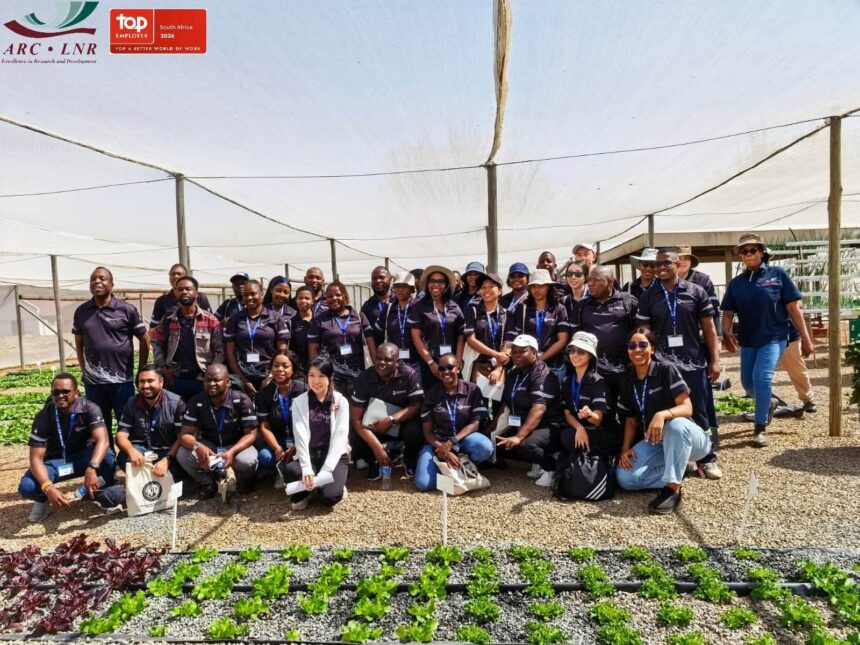
Water is one of the most important resources in agriculture, and finding ways to grow more vegetables with less water is becoming increasingly important for farmers and food producers. At the Agricultural Research Council’s Vegetable, Industrial and Medicinal Plants (ARC-VIMP), hydroponics research is exploring practical ways to produce crops efficiently without relying entirely on traditional soil-based farming. From tomatoes and cucumbers to peppers, herbs and leafy vegetables, hydroponic systems can provide plants with carefully managed water and nutrients. This approach can help growers make better use of limited water resources while producing high-quality vegetables in relatively small spaces. ARC-VIMP’s research is helping explore how these technologies can be adapted to practical agricultural conditions. The work is particularly relevant as farmers look for production methods that can improve resource efficiency while maintaining reliable crop yields.
Hydroponics is a method of growing plants without traditional soil, with crops receiving water and essential nutrients through a controlled growing system. Instead of depending on soil to supply nutrients, growers provide plants with carefully managed nutrient solutions that are delivered directly to the root zone. Depending on the system, roots can sit in a nutrient solution, receive regular irrigation or be exposed to nutrient-rich mist. The controlled nature of hydroponics gives growers greater control over water and nutrient delivery. This can reduce unnecessary water use and allow plants to receive resources according to their specific growth requirements. The technology can also make vegetable production possible in locations where suitable soil is limited or unavailable.
At ARC-VIMP, hydroponics research is focused on finding better ways to grow vegetables while making efficient use of available water and other resources. The Agricultural Research Council plays an important role in agricultural research aimed at supporting farmers and improving production practices. Research into hydroponics can provide useful information about how different systems perform with different vegetable crops and under different growing conditions. The work also looks beyond hydroponics, including research into how organic soil amendments can support crops such as tomatoes, cabbage and green beans. This broader approach recognises that farmers have different production environments and may need different solutions. By connecting research with practical farming needs, ARC-VIMP can help identify methods that support more efficient and sustainable vegetable production.
One of the hydroponic systems being explored is the Nutrient Film Technique, which delivers an oxygen-rich nutrient solution to plant roots through a controlled flow. The system is designed to provide plants with access to water and nutrients while maintaining oxygen around the roots. Nutrient Film systems can be used for a variety of crops, including lettuce, strawberries, herbs, tomatoes, peppers, eggplant and cucumbers. The nutrient solution can often be circulated through the system, allowing growers to manage water use more precisely. This makes the system particularly interesting for growers seeking to improve water efficiency. However, successful production requires careful monitoring of nutrient levels, water flow and the overall health of the plants.
Drip watering is another hydroponic approach that can be useful for small businesses, schools and hobby growers. The system delivers water and nutrients directly to individual plants through controlled drip lines. Tomatoes, cucumbers, peppers and herbs can be grown using this method, while flowers can also be produced in suitable systems. Because water is delivered close to the roots, growers can reduce unnecessary irrigation and have greater control over how much water each crop receives. Drip systems can also be adapted to different growing spaces, making them suitable for a range of production environments. Regular maintenance is important because blocked lines, incorrect water flow or nutrient problems can quickly affect plant growth.
The Ebb and Flow system uses a flood-and-drain approach to deliver water and nutrients to plants. The growing area is periodically flooded with nutrient-rich water before the solution drains away, allowing air to return to the root zone. This system is particularly suitable for root cuttings, germinating seedlings and young plants that require carefully managed growing conditions. The timing and frequency of the flooding cycles can be adjusted according to the needs of the plants. Good drainage is essential because excessive moisture around roots can create conditions that encourage root problems. When properly managed, Ebb and Flow systems can provide an effective environment for establishing healthy plants.
Aeroponics offers another highly controlled method of growing plants without traditional soil. In an aeroponic system, plant roots are exposed and sprayed with nutrient-rich water rather than being placed directly in soil. This provides the roots with access to both nutrients and oxygen while allowing growers to control the amount of water delivered. Aeroponics can be used for starting seedlings and can also support crops through to maturity. The technology can be highly efficient, but it requires reliable equipment and close monitoring because an interruption in the spray system can quickly affect the plants. For this reason, growers need to understand both the benefits and technical requirements before adopting aeroponic production.
Passive hydroponic systems provide a simpler option for homes, offices and other small growing environments. These systems allow plants to take up water and nutrients as needed without relying on more complex active irrigation equipment. Passive systems can be used for many types of crops and can provide an accessible introduction to hydroponic vegetable production. They are particularly useful for people who want to grow fresh vegetables in small spaces without investing in sophisticated equipment. Even with a simple system, growers need to manage water quality, nutrient availability, light and plant health. Understanding the basic needs of each crop remains essential for achieving successful results.
One of the biggest attractions of hydroponics is its potential to improve water efficiency. Traditional soil-based irrigation can result in water being lost through evaporation, runoff or areas of the soil where plant roots do not directly benefit from the moisture. Hydroponic systems can deliver water directly to the roots and, in some systems, allow unused water to be collected and reused. This can help reduce waste and make better use of every unit of water available to the grower. Hydroponics does not eliminate the need for water, because plants still require adequate moisture for growth. Its advantage comes from providing greater control over where and when water is delivered.
Hydroponics can also make it possible to produce vegetables in areas where traditional soil-based cultivation is difficult. Urban growers, schools, households and small businesses can establish hydroponic systems in relatively compact spaces. Some systems can also be arranged vertically, allowing growers to make better use of limited floor space. This can create opportunities for fresh vegetable production in areas where access to productive agricultural land is restricted. Farmers can also consider hydroponics as a complementary production method alongside conventional farming. The flexibility of the technology means that it can serve different types of growers depending on their available resources and production objectives.
Another advantage is that hydroponic growers do not need to prepare large areas of soil or spend the same amount of time controlling weeds. Traditional vegetable production can require substantial work to prepare planting beds and manage weeds throughout the growing season. Hydroponics removes many of these soil-related tasks because plants are grown in controlled systems instead of directly in agricultural soil. However, the method still requires careful management, with attention shifting towards water quality, nutrient levels, plant health, equipment and environmental conditions. Growers also need to monitor systems regularly to identify problems before they affect an entire crop. Hydroponics changes the nature of crop management rather than eliminating the need for careful agricultural work.
The potential to produce high-quality vegetables in smaller spaces makes hydroponics particularly relevant to modern food production. Crops such as tomatoes, cucumbers and peppers can perform well when they receive appropriate nutrients, water, light and support. Leafy vegetables and herbs can also be suitable for controlled hydroponic environments. Because growers have greater control over growing conditions, they can manage the delivery of resources more precisely than in many conventional systems. However, different crops have different requirements, so growers need to select systems that match their production goals. Crop selection, system design and careful management all contribute to the success of a hydroponic operation.
ARC-VIMP’s research is also considering how organic soil amendments can support vegetable production. Crops such as tomatoes, cabbage and green beans can benefit from improved soil conditions when suitable organic materials are incorporated into soil-based production systems. Research into soil amendments complements hydroponics by recognising that sustainable vegetable production can involve several different approaches. Some farmers may benefit from hydroponic systems, while others may find improved soil management more suitable for their land and resources. Understanding the performance of different production methods allows researchers to provide information that can support better decisions. This research can help farmers identify approaches that make efficient use of water, soil and other agricultural resources.
The importance of this research extends beyond individual farms because efficient vegetable production can contribute to broader food security goals. Farmers need reliable methods that allow them to produce food while managing increasingly important constraints such as water availability and limited productive land. Technologies such as hydroponics can provide additional options for farmers and other growers seeking to increase production efficiency. Research is essential because successful adoption requires more than simply installing a hydroponic system. Growers need information about crop selection, nutrients, water management, system maintenance and production costs. Practical research can help ensure that new technologies are introduced in ways that respond to real agricultural conditions.
The work being done through ARC-VIMP shows how agricultural research can help address one of the biggest challenges facing vegetable producers, growing food while using water more efficiently. Hydroponics offers several systems, including Nutrient Film, drip watering, Ebb and Flow, aeroponics and passive systems, each with different applications and management requirements. These technologies can support vegetable production in small spaces, reduce the need for soil preparation and improve control over water and nutrient delivery. At the same time, research into organic soil amendments provides farmers with additional options for improving conventional vegetable production. The most suitable approach will depend on the farmer, crop, available resources and production environment. As water efficiency becomes increasingly important, ARC-VIMP’s hydroponics research can help farmers explore practical ways to produce quality vegetables while making better use of every drop of water available.
Join 'Farmers Mag' WhatsApp Channel
Get the latest Farming news and tips delivered straight to your WhatsApp
CLICK HERE TO JOIN




