

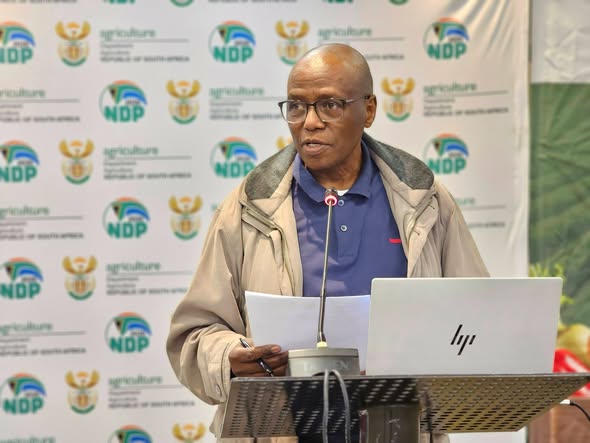
The Farmer Field School (FFS) Inception Meeting has brought together key agricultural stakeholders to advance the institutionalisation and national rollout of the Farmer Field School approach across South Africa. The meeting brought together the National Department of Agriculture, provincial departments, research institutions and other stakeholders with a shared focus on strengthening practical farmer support. At the centre of the initiative is a field-based learning approach that allows farmers to develop skills through direct experience, observation, experimentation and problem-solving. Rather than relying only on classroom-based training, Farmer Field Schools place farmers in practical settings where they can test solutions and assess what works under real production conditions. The initiative represents an important step towards strengthening agricultural extension services while helping farmers become better equipped to respond to production challenges and changing market demands.
The Farmer Field School approach is designed around the principle that farmers learn effectively when they can actively participate in the learning process. Farmers can observe production challenges, discuss possible solutions, test different practices and evaluate the results together. This practical process gives farmers an opportunity to build knowledge that directly relates to their own farming conditions. It can also help producers understand why certain agricultural practices work rather than simply receiving instructions about what they should do. By encouraging farmers to learn through experimentation and shared experience, the FFS approach can support stronger decision-making and improve the ability of farmers to adapt to challenges.
One of the important objectives of the national rollout is to help farmers respond more effectively to production challenges. Agricultural producers face a wide range of issues that can affect their productivity and profitability, including pests, diseases, changing weather conditions, soil management challenges and input costs. Farmer Field Schools can provide a structured environment where farmers investigate these challenges and identify practical responses. Researchers and extension practitioners can contribute technical knowledge while farmers contribute their own experience and understanding of local conditions. This two-way exchange can make agricultural support more relevant and increase the likelihood that new practices will be successfully applied in the field.
The approach also places a strong emphasis on sustainable farming practices. Farmers need production methods that protect natural resources while allowing them to maintain productivity and improve the long-term viability of their businesses. Through field-based experimentation, participants can assess different approaches to managing crops, soil, water, pests and other agricultural resources. This can help farmers identify practices that are suited to their specific production environments rather than adopting methods without understanding how they will perform locally. Promoting sustainability through practical learning can therefore contribute to more resilient farming systems and stronger food production over time.
Market-oriented decision-making is another important element of the Farmer Field School approach. Producing food successfully is only one part of running a sustainable agricultural enterprise because farmers also need to understand demand, quality requirements, costs and potential markets. FFS activities can help farmers consider how production decisions affect the commercial performance of their farming businesses. By linking technical knowledge with market considerations, farmers can make more informed choices about what they produce and how they manage their operations. This can support a shift towards farming practices that focus not only on production but also on income generation, business sustainability and access to markets.
The initiative also seeks to strengthen cooperation between farmers and the people and institutions that support agricultural development. Extension practitioners have an important role in connecting farmers with technical knowledge, government programmes and other agricultural services. Research institutions can contribute scientific knowledge and help test innovations that may address practical challenges faced by producers. Farmers, meanwhile, provide valuable knowledge based on their experiences and the conditions in which they operate. Bringing these groups together through Farmer Field Schools can create stronger links between research, extension and agricultural production.
The Inception Meeting provided an opportunity for participating organisations to clarify their roles and strengthen partnerships ahead of implementation. A coordinated approach is important when rolling out a national agricultural programme because different institutions bring different areas of expertise and resources. Clear roles can reduce duplication and help ensure that activities are directed towards common objectives. The meeting also helped shape a practical roadmap for implementation, giving stakeholders a clearer understanding of how the Farmer Field School approach can be expanded. Strong coordination will be important as the programme moves from planning into practical work with farmers across the country.
The involvement of provincial departments is particularly important because agricultural conditions differ significantly between regions. Farmers in different provinces may work with different crops, livestock systems, climatic conditions, markets and production challenges. A national approach therefore needs to provide a consistent framework while allowing implementation to respond to local realities. Provincial agricultural structures can help adapt Farmer Field School activities to the needs of local farming communities and connect the programme with existing extension services. This combination of national coordination and local implementation can help make the approach practical and relevant to farmers in different parts of South Africa.
Research institutions also have an important role to play in ensuring that knowledge generated through agricultural research reaches farmers in a usable form. Scientific findings can have limited impact if farmers cannot access, understand or apply them in their own production systems. Farmer Field Schools create an opportunity to take research closer to the field and allow farmers to evaluate new ideas through practical experimentation. This can also give researchers valuable feedback about how technologies and production practices perform under real farming conditions. Stronger links between research and farmers can help accelerate the adoption of useful innovations while ensuring that future research responds to actual agricultural needs.
The national rollout of Farmer Field Schools could also strengthen the role of farmers as active participants in agricultural development. Farmers are not simply recipients of information within this model, as they contribute their own observations, experiences and ideas to the learning process. Working collectively can help farmers identify common challenges and develop solutions that reflect local knowledge and practical realities. Group learning can also encourage cooperation and strengthen relationships among producers within farming communities. These benefits can extend beyond individual farms by helping communities develop stronger networks for sharing knowledge and responding to agricultural challenges.
The Farmer Field School Inception Meeting has therefore laid an important foundation for a more practical and collaborative approach to agricultural extension in South Africa. By bringing together the National Department of Agriculture, provincial departments, research institutions and other stakeholders, the initiative is creating a framework for farmers to learn, experiment, solve problems and make informed decisions. Its focus on sustainable practices, production challenges, market opportunities and collaboration can help strengthen the capacity of farmers while supporting more resilient food systems. The success of the national rollout will depend on effective partnerships, consistent implementation and continued engagement with farmers at field level. When farmers have the opportunity to learn through practical experience and work with others to develop solutions, they are better positioned to improve their enterprises, adapt to changing conditions and contribute to a stronger and more resilient agricultural sector.
Join 'Farmers Mag' WhatsApp Channel
Get the latest Farming news and tips delivered straight to your WhatsApp
CLICK HERE TO JOIN




