Onions are among the most widely grown and consumed vegetable crops in South Africa, making them an important part of both commercial agriculture and household food production. Their versatility in the kitchen, long storage life and consistent market demand have made onions a profitable crop for farmers of all sizes. Whether sold fresh, processed or stored for later marketing, onions provide producers with opportunities to generate income throughout the year. However, successful onion farming begins long before harvest, with careful planning and proper crop establishment. Understanding the basics of site selection, soil preparation, climate requirements and transplanting is essential for producing healthy plants and achieving high-quality bulbs.
The cultivation of onions has a long history, with the crop having been grown and consumed for centuries around the world. Scientifically known as Allium cepa L., onions are valued for their distinctive flavour and are used in countless dishes, salads, pickles and processed food products. Both mature and immature onions are consumed, making the crop highly versatile in local and export markets. In some farming systems, onions are also used as companion plants because they can help repel certain insect pests that attack neighbouring vegetable crops. Another major advantage is their excellent storage potential, as properly cured onions can be stored for extended periods and marketed when prices are more favourable, giving farmers greater flexibility in managing their income.
South Africa’s onion industry benefits from production taking place across several regions with varying climatic conditions. Each production area has a specific harvesting window before supplies from another region enter the market. This staggered production cycle helps ensure a continuous supply of onions throughout much of the year while allowing growers to target different market opportunities. Timing remains critical because market prices can fluctuate depending on supply levels. Careful production planning enables farmers to maximise returns by harvesting and marketing onions during favourable periods.
Selecting the right site is one of the most important decisions when establishing an onion crop. Although onions can adapt to different soil types, they perform best in deep, fertile loamy soils that are well drained to a depth of approximately 120 centimetres. Good drainage prevents waterlogging, which can damage root systems and increase the risk of fungal diseases. Soil should also be free from compaction to encourage healthy root development and uniform bulb formation. Before planting, farmers are encouraged to conduct soil tests to determine nutrient levels and identify any amendments needed to create ideal growing conditions.
Maintaining the correct soil pH is equally important for successful onion production. Onions grow best in soils with a pH ranging between 5.5 and 6.5, where nutrients remain readily available for plant uptake. If soil acidity falls outside this range, corrective measures such as liming may be required before planting begins. Crop rotation should also form part of every onion production programme because repeated planting in the same field can increase disease pressure and reduce yields. Rotating onions with crops outside the Allium family, particularly legumes such as beans and peas, helps improve soil fertility while reducing the buildup of pests and diseases.
Climate plays a significant role in determining the growth and development of onion crops. The ideal temperature for onion growth ranges between 18 and 22 degrees Celsius, providing conditions that support healthy vegetative growth and bulb development. Higher temperatures of between 25 and 27 degrees Celsius accelerate bulb formation, while prolonged exposure to cooler temperatures between 8 and 13 degrees Celsius can trigger bolting, where plants produce flower stalks instead of quality bulbs. Temperature management is therefore essential for achieving high yields and marketable produce. Farmers should select planting dates that align with favourable seasonal conditions in their production areas.
Day length, also known as the photoperiod, is another critical factor influencing onion production. Unlike many other vegetable crops, onions begin forming bulbs only after receiving a certain number of daylight hours. Short-day onion varieties require fewer daylight hours and are generally suited to warmer regions, while intermediate-day cultivars need longer periods of daylight before bulbing begins. Intermediate-day varieties are commonly grown south of Welkom, where seasonal daylight conditions better suit their growth requirements. Selecting the appropriate cultivar for a specific region is essential because incorrect variety selection can result in poor bulb development and reduced yields.
Farmers can establish onion crops either by sowing seeds directly into the field or by producing seedlings for later transplanting. While direct seeding is commonly used by experienced producers, transplanting seedlings is generally recommended for beginner farmers because it offers greater control during the early stages of crop establishment. Healthy seedlings are more likely to survive adverse conditions and establish uniform plant populations. Producing quality seedlings begins with careful seedbed preparation. Fine-textured soil promotes good seed-to-soil contact, allowing for even germination and healthy root development.
Seeds should be sown in rows approximately 15 centimetres apart at a depth of between 10 and 15 millimetres. Avoid sowing seeds too densely because overcrowding produces weak, spindly seedlings that do not transplant well. Recommended sowing densities range between 1,500 and 2,500 seeds per square metre, using approximately seven grams of seed per square metre. During periods of very hot weather, a thin layer of grass can be applied as mulch to help retain soil moisture and protect emerging seedlings. The mulch should be removed as soon as seedlings emerge, usually within seven to fourteen days, to prevent excessive elongation and sunburn.
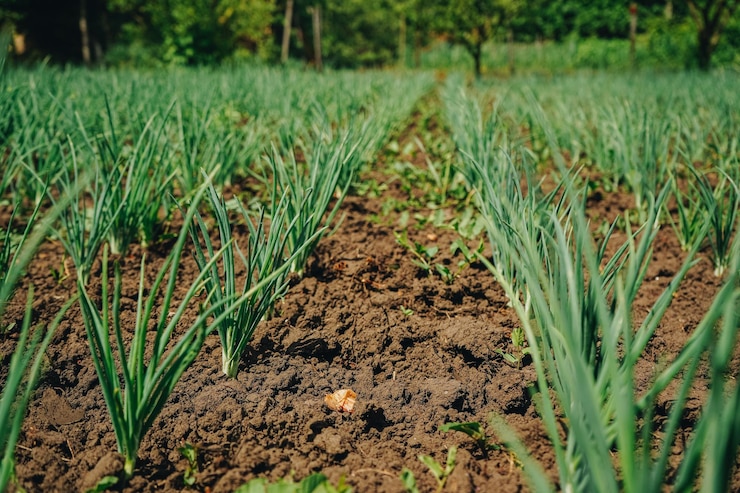
Seedlings become ready for transplanting once they reach a diameter of approximately eight to nine millimetres, roughly the thickness of a pencil, and a height of between 12 and 20 centimetres. Short-day onion varieties generally reach this stage within six to eight weeks after sowing. It is important not to trim the leaves before transplanting because healthy foliage supports continued plant growth during establishment. Seedlings should be placed into shallow furrows between two and four centimetres deep, ensuring that only the white stem portion is covered with soil. Planting too deeply can lead to elongated bulbs and reduced market quality.
Field preparation before transplanting contributes significantly to successful crop establishment. Raised beds measuring between one and 1.2 metres wide with pathways of 0.5 to 0.7 metres provide good drainage and allow easier access for irrigation, weeding and harvesting. Soil from the pathways is typically used to build beds eight to ten centimetres high. Onion seedlings should be planted seven to ten centimetres apart within rows spaced 20 to 25 centimetres apart, resulting in a plant population of approximately 50 to 60 plants per square metre. This spacing provides enough room for healthy bulb development while making efficient use of available land.
The first few days after transplanting are particularly important because seedlings experience stress while adapting to their new environment. Keeping the soil consistently moist for the first five days helps plants overcome transplant shock and encourages rapid root establishment. Adequate moisture during this period improves survival rates and supports vigorous early growth. Farmers should monitor irrigation carefully to avoid both water stress and excessive watering, which can negatively affect root development. Good management during this stage lays the foundation for healthy plants capable of producing high-quality bulbs later in the season.
Establishing a successful onion crop requires careful attention to every stage of production, from selecting the right site and preparing fertile soil to choosing suitable varieties and applying proper transplanting techniques. These early production practices determine the strength, health and productivity of the crop throughout the growing season. Farmers who invest time in proper planning and crop establishment are more likely to achieve uniform stands, larger bulbs and higher yields. As onions continue to be one of South Africa’s most valuable vegetable crops, mastering these production fundamentals remains essential for long-term farming success. In Part 2, we will explore crop nutrition, irrigation management, harvesting techniques, storage methods and effective strategies for managing the pests and diseases that can affect onion production.
Join 'Farmers Mag' WhatsApp Channel
Get the latest Farming news and tips delivered straight to your WhatsApp
CLICK HERE TO JOIN