

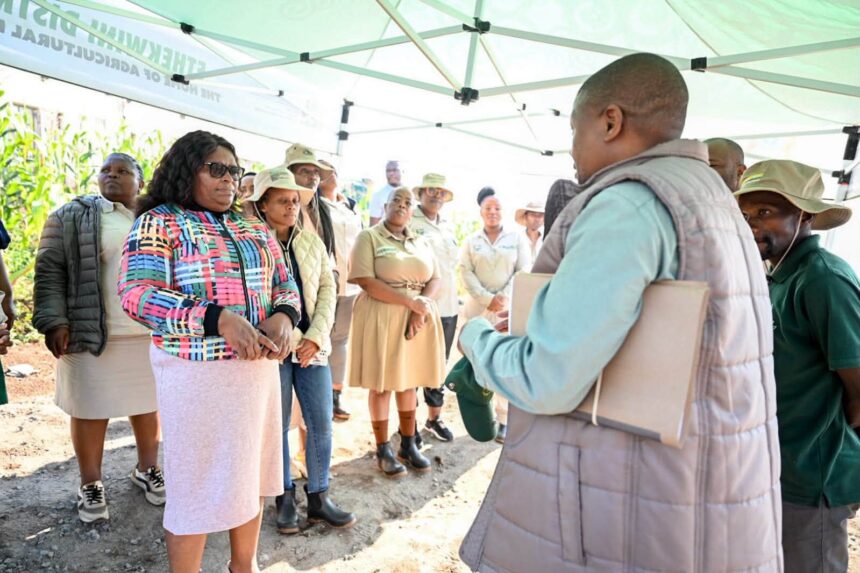
The KwaZulu-Natal Department of Agriculture and Rural Development continues to strengthen its commitment to supporting emerging farmers through targeted investments and practical development initiatives. This commitment was evident when the KwaZulu-Natal MEC for Agriculture and Rural Development, Mrs Thembeni kaMadlopha-Mthethwa, conducted Operation Siyahlola at Vuka Supply Farm in uMbumbulu within the eThekwini Municipality. The visit formed part of the department’s ongoing efforts to assess agricultural activities, monitor government support programmes and ensure that public resources are delivering meaningful results for farming communities. During her visit, the MEC expressed her satisfaction with the remarkable transformation of a previously non-viable school into a thriving agricultural enterprise. She described the project as an outstanding example of how unused public infrastructure can be repurposed to support food production, create employment and stimulate rural economic development.
Operation Siyahlola is designed to ensure that government support reaches the intended beneficiaries while promoting accountability and sustainable agricultural growth. Rather than relying solely on reports, the programme allows officials to inspect projects on the ground and evaluate their progress firsthand. According to MEC kaMadlopha-Mthethwa, the initiative provides an opportunity to confirm that agricultural equipment, infrastructure and production inputs are being used effectively to improve farming operations. She emphasized that government investments must translate into increased food production, stronger local economies and more employment opportunities for surrounding communities. The visit to Vuka Supply Farm demonstrated how effective support and proper management can transform a farming project into a successful commercial enterprise.
As part of the department’s comprehensive farmer support programme, Vuka Supply Farm received substantial assistance aimed at expanding production capacity and improving operational efficiency. The department supplied a tractor together with ten agricultural tunnels, which have already been erected to increase crop production throughout the year. Additional support included the donation of manure and all-season fertilizer to improve soil fertility and maximize crop yields. These resources provide the farm with essential tools to increase productivity while ensuring consistent production despite changing weather conditions. By investing in both infrastructure and production inputs, the department is helping emerging farmers establish sustainable businesses that can compete in commercial agricultural markets.
MEC kaMadlopha-Mthethwa stressed that Operation Siyahlola is about ensuring that government resources produce measurable benefits for communities. She explained that the department is committed to verifying that every investment contributes to increased agricultural production and job creation. The MEC noted that seeing projects firsthand allows the department to identify successful models that can be replicated elsewhere across the province. Her assessment of Vuka Supply Farm confirmed that the investment is delivering significant value while creating opportunities for economic growth in uMbumbulu. She believes the project demonstrates how strategic support can unlock the potential of emerging farmers when combined with commitment and proper management.
One of the most notable aspects of the project is the successful conversion of an abandoned and non-functional school into a productive agricultural enterprise. The MEC described this transformation as one of the most impressive features of the project and encouraged district officials to adopt similar approaches in other parts of KwaZulu-Natal. She issued a directive to District Directors that unused schools should be identified and assessed for possible conversion into agricultural projects wherever practical. According to the MEC, many of these facilities already have valuable infrastructure that can be adapted for farming activities. Existing classrooms can be converted into storage facilities, workshops, training centres and administrative offices, reducing development costs while giving new purpose to unused public buildings.
The department’s investment in Vuka Supply Farm has already produced encouraging results that extend beyond infrastructure development. MEC kaMadlopha-Mthethwa noted that the project represents excellent value from the department’s R3.6 million investment, with the farm now featuring nearly every essential resource required for successful agricultural production. She also praised beneficiary Mr Mondli Shangase for contributing to the project’s success by installing his own borehole, further strengthening the farm’s long-term sustainability. The combination of government support and private initiative has created a strong foundation for continued growth and expansion. This partnership demonstrates how public investment can achieve even greater impact when matched by the commitment and determination of beneficiaries.
The Agribusiness Development Agency has also played an important role in the project’s success by identifying a suitable beneficiary capable of maximizing the available resources. As a result, the department now views Vuka Supply Farm as a flagship project that can serve as a practical example for similar initiatives across KwaZulu-Natal. The project illustrates how coordinated support from government institutions can accelerate agricultural development while creating lasting economic opportunities. It also highlights the importance of selecting committed beneficiaries who are prepared to invest their own effort and resources into achieving long-term success. Such partnerships strengthen confidence in government development programmes and encourage further investment in rural communities.
Human capital development has also been prioritized through the placement of five agricultural graduates at the project. These graduates provide technical expertise, assist with modern farming practices and help ensure that production systems remain efficient and sustainable. Their involvement allows the project to benefit from current agricultural knowledge while providing valuable workplace experience for young professionals entering the agricultural sector. The arrangement also supports skills transfer between experienced farmers and newly qualified graduates, creating long-term benefits for both parties. Developing technical capacity alongside physical infrastructure increases the likelihood that projects such as Vuka Supply Farm will remain productive well into the future.
Mr Mondli Shangase, Director of Vuka Supply Farm, expressed his appreciation for the support received from the Department of Agriculture and Rural Development. He acknowledged that the assistance, including the tractor, ten tunnels, farming implements and production inputs, has significantly improved the farm’s operations across its 16 hectares of land. He also welcomed the placement of agricultural graduates, whose technical support continues to strengthen daily farming activities. In addition to benefiting from government assistance, the project has already created employment opportunities by hiring ten people from the local community. These jobs provide much-needed income while contributing to broader rural economic development.
The farm has already established itself as a productive commercial operation supplying fresh produce and grain products to major retailers around Durban. This demonstrates that emerging farmers can successfully access formal markets when supported with the appropriate infrastructure, technical expertise and production resources. Mr Shangase emphasized that the farm remains committed to maintaining its operations while contributing to the fight against food insecurity and unemployment within the surrounding communities. As production continues to grow, the project is expected to create even greater economic opportunities while strengthening local food supply chains. The success of Vuka Supply Farm shows that agriculture can become a powerful driver of inclusive economic development when supported through effective partnerships between government and local entrepreneurs.
The visit by MEC Thembeni kaMadlopha-Mthethwa through Operation Siyahlola highlighted the positive impact that targeted agricultural investment can have on communities across KwaZulu-Natal. The transformation of a previously unused school into a thriving agricultural enterprise demonstrates how innovative thinking, strategic government support and dedicated leadership can create sustainable farming businesses. With investments in infrastructure, production inputs, technical expertise and employment creation, Vuka Supply Farm has become a model that other districts can follow. The project’s success not only strengthens food production but also creates jobs, develops skills and stimulates rural economic growth. As the department continues to expand similar initiatives across the province, projects like Vuka Supply Farm have the potential to transform unused public assets into thriving agricultural hubs that improve livelihoods and contribute to a more food-secure South Africa.
Join 'Farmers Mag' WhatsApp Channel
Get the latest Farming news and tips delivered straight to your WhatsApp
CLICK HERE TO JOIN




