

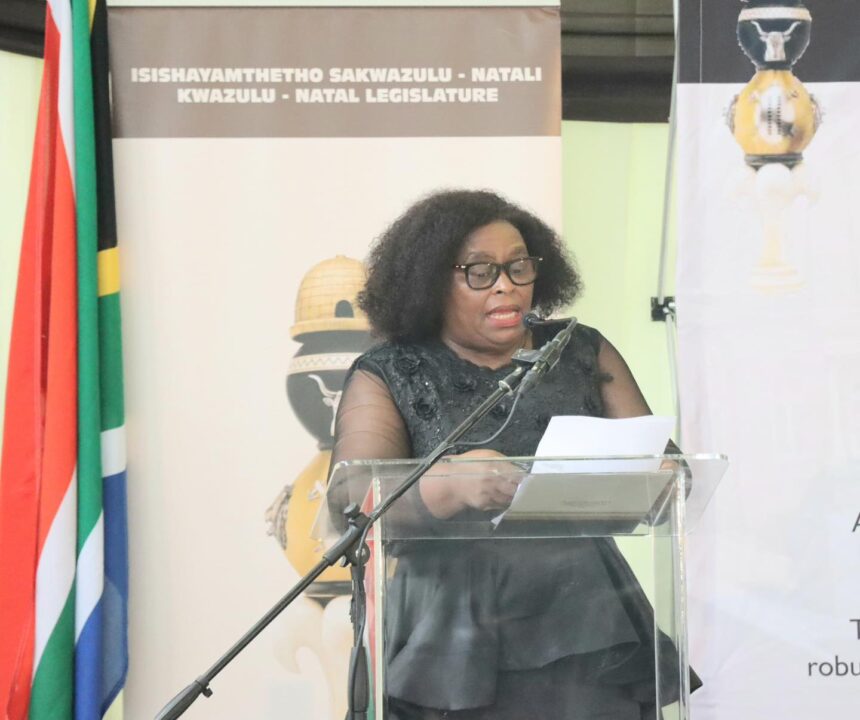
KwaZulu-Natal is placing renewed focus on rural development by linking agriculture with community structures that already have deep local reach. During the Interfaith Symposium hosted by the KwaZulu-Natal Legislature at the uMthonjaneni Indoor Sport Centre, government leaders outlined a practical plan to expand food production at grassroots level. Thembeni kaMadlopha-Mthethwa, serving as Acting Premier for the session, used the platform to call for stronger collaboration between government and faith-based organisations. The initiative, known as One Church One Garden, aims to convert underutilized rural land into productive agricultural spaces. This approach recognizes the influence and organisational strength of churches and other faith institutions. It also targets food security, job creation and local economic growth in one coordinated effort. The programme reflects a shift toward inclusive development that draws on community participation rather than relying only on state-led interventions.
The presence of senior officials, including Acting Head of Department Fikile Qwabe, reinforced the importance of aligning policy with implementation. Government leaders used the symposium to engage directly with religious leaders, who often manage large congregations across rural and peri-urban areas. These institutions already have land, volunteers and established communication networks, which makes them ideal partners for agricultural projects. By encouraging each church to develop and maintain a garden, the programme creates a simple but scalable model. Small plots can produce vegetables, support feeding schemes and generate surplus for local markets. This reduces pressure on households while promoting self-reliance. It also strengthens community cohesion through shared responsibility and visible results.
The One Church One Garden programme is designed to be practical and measurable. Participating organisations are expected to identify suitable land, prepare soil and begin planting crops suited to local conditions. Government departments will provide support through training, extension services and access to basic inputs where possible. This includes guidance on crop selection, irrigation methods and pest control. The goal is not only to produce food but also to build long-term agricultural skills within communities. Over time, these gardens can evolve into larger projects that contribute to local supply chains. The programme also encourages youth involvement, which helps address unemployment while building interest in agriculture as a viable career path.
The initiative fits into a broader strategy to transform rural landscapes in KwaZulu-Natal. Many rural plains remain underutilized despite having potential for crop production. By activating these spaces through community-driven projects, the province can increase output without major infrastructure expansion. Faith-based organisations provide a structured entry point for this transformation. They offer accountability, leadership and a sense of purpose that supports consistent participation. The government’s role is to enable and guide rather than control every aspect of the process. This balance increases the likelihood of sustainability and long-term impact.
The engagement at the symposium also highlighted the value of partnerships across sectors. Agriculture cannot grow in isolation from social institutions that shape daily life in rural areas. By working with faith-based organisations, the government taps into trusted networks that can mobilize people quickly. This approach reduces barriers to participation and improves the reach of development programmes. It also ensures that benefits are distributed more evenly across communities. The involvement of senior officials signals that this is not a symbolic initiative but a structured plan with clear objectives. Continued engagement will be needed to track progress and address challenges as they arise.
KwaZulu-Natal’s One Church One Garden initiative presents a focused path toward rural transformation. It combines policy direction, community engagement and practical action to address food security and economic challenges. The leadership shown by MEC Thembeni kaMadlopha-Mthethwa and her team sets a clear tone for implementation. By encouraging faith-based organisations to take an active role, the province is building a model that can scale across different regions. Success will depend on consistent support, monitoring and community commitment. If executed effectively, the programme can turn idle land into productive assets and strengthen rural livelihoods. This initiative positions agriculture as a shared responsibility and a key driver of sustainable development in KwaZulu-Natal.
Join 'Farmers Mag' WhatsApp Channel
Get the latest Farming news and tips delivered straight to your WhatsApp
CLICK HERE TO JOIN




