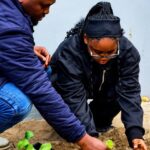
Petrus “Happy” Letsitsa farms maize, sunflowers, soya beans and livestock on two adjacent leased properties in Hennenman in the Free State. The farming operation covers just over 1 000 hectares of land. His entry into agriculture was not conventional. In 2015, he left a career in banking to farm full time. The decision marked a turning point that would reshape his professional life. He entered farming with limited scale but clear financial discipline.
When Happy started farming, his grain production stood at 250 tonnes. Over six years, he steadily increased output through careful planning and expansion. His production exceeded 1 000 tonnes, earning him recognition as one of Grain SA’s New Era Commercial Farmers. In 2022, this achievement secured his place in the prestigious 1 000 Ton Club. He currently produces more than 1 500 tonnes of grain on 550 hectares. His long term goal is to own land rather than lease it.
Happy’s enterprise combines grain production with livestock to spread risk and stabilise income. His sunflower seed supplies the margarine industry. Most of his maize is delivered to FarmSol for beer production. These offtake arrangements reduce market uncertainty and support predictable cash flow. He also runs about 50 Bonsmara crossbred cattle. Livestock sales help balance income when grain markets fluctuate.
Financial discipline underpins the success of the business. Happy continuously monitors expenses and keeps accurate records of all transactions. He retains tax invoices and closely watches his credit exposure. Financial information is escalated to his bookkeepers for processing and compliance. This approach ensures transparency and control. It also allows him to respond quickly to financial pressure points.
For budgeting, Happy relies on zero based budgeting. Each season starts from zero, with every cost requiring justification. This prevents unnecessary spending and forces efficiency. Planning begins well ahead of the production season. The method helps focus capital on high return activities. It also improves decision making under tight margins.
Managing cash flow outside the harvest period is one of the biggest challenges. Happy sells cash crops and livestock on informal markets to maintain liquidity. He also trades livestock by buying animals at auctions or from farmers and reselling them. During land clearing, he sells wood, particularly in winter. These activities generate income when crop revenue is limited. They help the business remain operational year round.
Happy manages debt cautiously and avoids short term loans where possible. After harvest, when income peaks, he allocates funds to an emergency account. He forecasts expenses up to ten months in advance. This planning allows him to cover operating costs without excessive borrowing. It also reduces financial stress during the production cycle. Long term stability takes priority over rapid expansion.
Grain prices are largely determined by SAFEX. Happy uses SAFEX pricing and hedges where possible through offtake agreements and contracts. Hedging reduces exposure to price volatility by locking in future prices. For livestock, he monitors weekly national red meat prices. This helps guide selling decisions and timing. Pricing decisions are based on data rather than speculation.
Happy does not use specialised farm financial software. He relies on his accountant to manage finances, tax affairs and insurance. This arrangement ensures compliance and accuracy. It also frees time to focus on production and planning. Professional support plays a key role in maintaining financial order. Clear division of responsibilities improves efficiency.
Before introducing a new crop or farming technique, Happy conducts thorough research. He consults farmers already producing that crop. New ideas are tested on a small scale first. Only once feasibility is proven does he expand production. This approach limits financial risk. It also prevents costly large scale failures.
Risk management is a priority across the operation. For risks within his control, Happy follows best practice and avoids shortcuts. This is especially critical during planting. He invests in soil testing and works closely with input suppliers. Insurance forms part of his risk strategy. His guiding principle is that prevention is better than cure.
Government grants play a supportive role in the business. Rising input costs make grants a useful buffer. When used correctly, they improve margins and build capacity. Grants help the business grow without increasing debt. They are not relied on as permanent support. The focus remains on long term independence.
Happy’s background in agri finance helped him understand lender expectations. He started small and scaled the business in line with skills and capacity. He secured funding through the Land Bank blended finance programme. He managed the process himself. Direct engagement with funders improved transparency. It also reduced reliance on intermediaries.
In the early stages, Happy worked with consultants. He later realised many were more focused on their own interests than farmer development. He chose to deal directly with funders and input suppliers. This shift reduced costs and improved relationships. It also gave him greater control over decisions. Experience taught him where real value lies.
At the end of each financial year, Happy reviews financial statements with his accountant. He also engages with financiers, input suppliers and mentors. These discussions help assess performance and identify improvements. Feedback guides future planning. Regular evaluation keeps the business accountable. It supports continuous improvement.
Succession planning is already in progress. His eldest son, Prince Letsitsa, is a third year information technology student. He plans to bring digital skills into the farming business. Happy is scaling up production to support future generations. His goal is to farm at least 2 000 hectares under grain. Growth is essential to accommodate family involvement.
The most important financial lesson Happy has learned is to pay bills on time. Financial reputation matters in agriculture. Being a bad payer damages trust. It limits access to finance and inputs. Strong relationships depend on reliability. Discipline protects long term opportunity.
His biggest mistake was overspending and skipping payments. These decisions placed unnecessary strain on the business. He corrected this by recording every expense. Purchases are now made only when necessary. Discipline replaced impulse. The lesson reshaped how the business operates today.
Petrus “Happy” Letsitsa’s journey shows that farming success is built on planning, discipline and learning. His transition from banking to agriculture was deliberate and strategic. Growth came through consistency rather than shortcuts. Financial control proved as important as production skills. His story offers practical insight for farmers building sustainable businesses in South Africa.
Join 'Farmers Mag' WhatsApp Channel
Get the latest Farming news and tips delivered straight to your WhatsApp
CLICK HERE TO JOIN