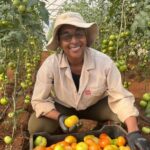

When prominent journalist Hopewell Chin’ono speaks about farming, people listen—not because he’s a celebrity or public figure, but because he’s living proof that farming, done intelligently, can build real wealth. What many don’t know is that Chin’ono’s love for agriculture runs deep in his family roots.
“I am the son of a man who taught the whole Murewa district how to farm — ndiri mwana wemudhomeni,” he says proudly. His late father was a well-known agricultural educator who trained farmers across Murewa. “When my father retired in 1986, he started breeding pigs at our village home. He made tonnes of money by his standard while sitting quietly in the village,” Chin’ono recalls.
He grew up travelling with his father to different parts of Murewa as a child while his father taught villagers how to plough, plant, and manage livestock. “It became second nature to me,” he adds. “My father told me that a man should never starve as long as he has a piece of land, a working brain, and the energy to use it.”

When his father passed away, the ancestral home became his by tradition. It was there that Chin’ono established a Boer goat breeding project that would later become one of Zimbabwe’s most successful farming ventures. “The only difference is that I started mine at a village home, not on a commercial farm,” he explains. “But I outperformed many who were already on established farms.”
For Chin’ono, goat farming is not just about prestige—it’s about practical economics. “A Boer goat gives birth to three kids, twice a year during its peak; that’s six kids a year. If you have 100 females, that’s 600 offspring annually. If you sell those 600 at US$400 each, that’s US$240,000 a year—before expenses,” he explains.

He laughs when recalling how people initially mocked him for promoting Boer goats. “People laughed when I told them about Boer goats. They said, ‘Who pays $1,000 for a goat?’ They didn’t know they can fetch up to $100,000 each depending on genetics,” he says. “Now imagine not selling those 600 kids but letting them breed after 12 months—unofa nemari (you’ll die rich). No tenders, no shady deals; just honest, straightforward farming.”
What separates Chin’ono from many farmers is his commitment to learning. “I sat in my study with the owner and CEO of Pro-Feeds, learning about goat feed and getting guidance on what works best for my setup,” he says. “That hard work is never seen on social media; you only see the goats when they’re breeding. But there’s a lot of planning and effort behind the scenes.”

He emphasizes that there is still a significant shortage of Boer goats in Zimbabwe, especially for crossbreeding. “So don’t say I didn’t share our industry secrets,” he says with a smile. “Commercial farmers need them—and I told you how to get started.”
Chin’ono has also spoken candidly about the misconceptions people have about wealth creation through farming. “It saddens me when adults spend hours debating how someone made their money,” he says. “If our people opened their minds and learned without the ‘I know it all’ attitude, they would do better in life. Some are silent during the hard work but loud when it’s time to reap.”

Whether in journalism or farming, Hopewell Chin’ono has remained consistent in using knowledge to empower others. His journey is a masterclass in what’s possible when Africans approach agriculture not as mere survival, but as a business. “People laughed when I started,” he reflects. “But today, some of the same critics buy goats from me. I told Zimbabweans that goat farming can change lives—I still believe that.”

His parting advice to aspiring farmers is simple yet profound: “Start small. Learn. Crossbreed. Be patient. The land doesn’t lie. The goats will reward you if you respect the process.”
Join 'Farmers Mag' WhatsApp Channel
Get the latest Farming news and tips delivered straight to your WhatsApp
CLICK HERE TO JOIN