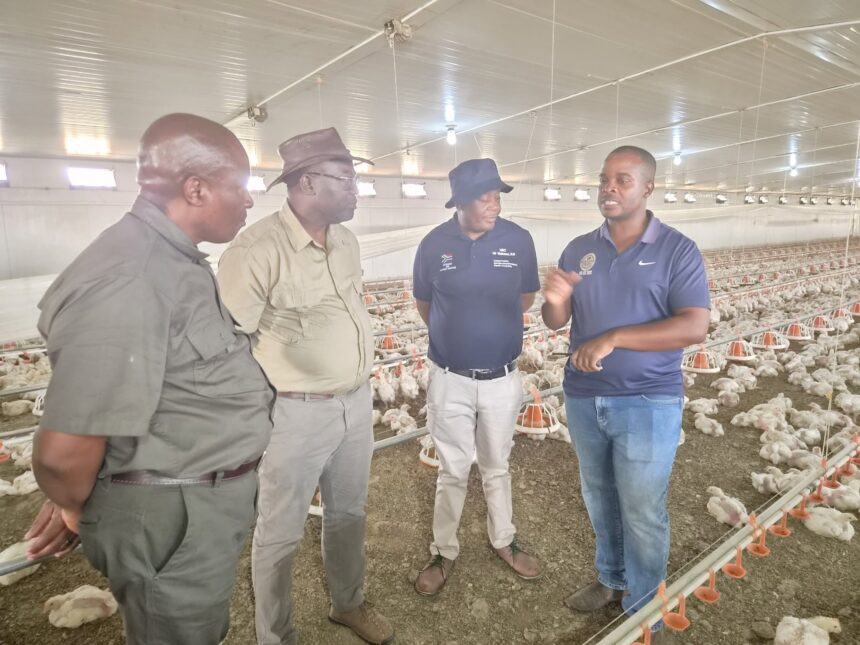
Limpopo is strengthening support for local agricultural enterprises after MEC for Agriculture and Rural Development Basikopo Makamu visited SL & Sons poultry farm in the Modimolle-Mookgophong Municipality. The visit followed a productive engagement with Waterberg District staff and included Head of Department Mpho Mashamba and support teams from the department’s Head Office and the Waterberg District. The delegation toured the poultry enterprise owned by local farmer Percy Makola to assess the progress and impact of the agricultural investment. The visit highlighted how targeted government support can help local farmers expand their operations and improve production efficiency. It also demonstrated the potential of partnerships between government and private agricultural enterprises to support food security and rural economic development in Limpopo.
A major focus of the visit was the state-of-the-art automated chicken house constructed through an investment by the Limpopo Department of Agriculture and Rural Development. The facility can accommodate up to 40,000 birds, representing a significant increase in the farm’s production capacity. Its automated systems are designed to manage essential poultry farming functions, including feeding, watering and climate control. Automation can reduce the amount of manual work required while allowing farmers to manage large numbers of birds more efficiently. The investment therefore provides SL & Sons with infrastructure designed to support commercial-scale poultry production and strengthen the operational capacity of the business.
The automated chicken house also demonstrates the growing importance of technology in modern agriculture. Poultry production requires careful management of feeding, water supply, temperature and other environmental conditions to maintain healthy birds and consistent production. Automated systems can help farmers manage these processes with greater precision and efficiency. The ability to accommodate 40,000 birds gives the enterprise an opportunity to operate at a larger commercial scale while using modern production infrastructure. Such investments can help agricultural businesses improve their productivity and create a stronger foundation for future growth.
The visit also placed attention on the role of local farmers in strengthening food security in Limpopo. Poultry farming contributes to the supply of chicken and other products to consumers while creating economic opportunities within rural communities. When local agricultural enterprises increase their production capacity, they can potentially participate more effectively in local and broader agricultural value chains. This can generate demand for related services and inputs, including feed, transport, equipment and other business support. Supporting viable commercial farms can therefore have effects that extend beyond the individual farming enterprise.
MEC Basikopo Makamu commended Percy Makola for his dedication to commercial farming and the development of SL & Sons. His visit provided an opportunity for the provincial government to acknowledge the work being done by a local farmer while highlighting the importance of continued support for agricultural entrepreneurs. The department’s investment in the automated poultry facility reflects an approach focused on providing productive infrastructure that can support business expansion. Such assistance can help farmers overcome some of the infrastructure challenges that may limit their ability to increase production. It also reinforces the importance of cooperation between government institutions and agricultural businesses.
The presence of Head of Department Mpho Mashamba and support teams from the Head Office and Waterberg District further highlighted the department’s broader involvement in supporting agricultural development. Engagements at farm level allow government officials to see how agricultural investments are being used in practice. They also create an opportunity to understand the operational needs of farmers and identify areas where additional support may be required. Regular engagement can help strengthen communication between farmers and government institutions responsible for agricultural development. This can contribute to better alignment between public investments and the practical needs of farming enterprises.
For the Modimolle-Mookgophong Municipality, the development at SL & Sons represents an example of agricultural activity contributing to the local economy. A larger poultry operation can support employment opportunities and create demand for services from businesses operating within the surrounding area. Increased production can also strengthen connections between the farm and other participants in the poultry value chain. The broader economic impact will depend on how the enterprise develops and how effectively it connects with suppliers, markets and local communities. Nevertheless, productive agricultural investments provide an important base for rural economic activity.
The development is also relevant to Limpopo’s efforts to promote sustainable rural economic development. Rural communities require economic opportunities that can support livelihoods and encourage productive use of available agricultural resources. Commercial farming enterprises can contribute to this process when they receive appropriate infrastructure, technical support and access to markets. The investment at SL & Sons shows how agricultural infrastructure can be used to support an existing enterprise rather than simply providing short-term assistance. Expanding productive capacity can give farmers a stronger platform from which to build sustainable businesses.
The poultry sector remains an important part of agriculture because it supplies widely consumed food products while supporting a network of businesses and workers. Modern infrastructure can help farmers manage production at scale and respond to market demand. At SL & Sons, the 40,000-bird automated facility provides the infrastructure needed to expand the enterprise while improving the efficiency of key production processes. The success of the investment will ultimately depend on factors such as effective farm management, market access, operating costs and the continued health of the poultry operation. Government support can provide an important foundation, but long-term commercial sustainability will require the enterprise to continue operating efficiently.
The visit to SL & Sons poultry farm provides a practical example of how public investment can support private agricultural development in Limpopo. By investing in a modern automated chicken house, the provincial Department of Agriculture and Rural Development has helped provide infrastructure capable of supporting a substantially larger poultry operation. The visit also reinforced the department’s stated commitment to empowering local agri-preneurs, strengthening food security and supporting rural economic development. Percy Makola’s enterprise demonstrates the potential of local farmers to build commercial agricultural businesses when they have access to appropriate infrastructure and institutional support. As Limpopo continues to develop its agricultural economy, investments that increase productive capacity and strengthen local enterprises can play an important role in creating a more resilient and productive rural economy.
Join 'Farmers Mag' WhatsApp Channel
Get the latest Farming news and tips delivered straight to your WhatsApp
CLICK HERE TO JOIN