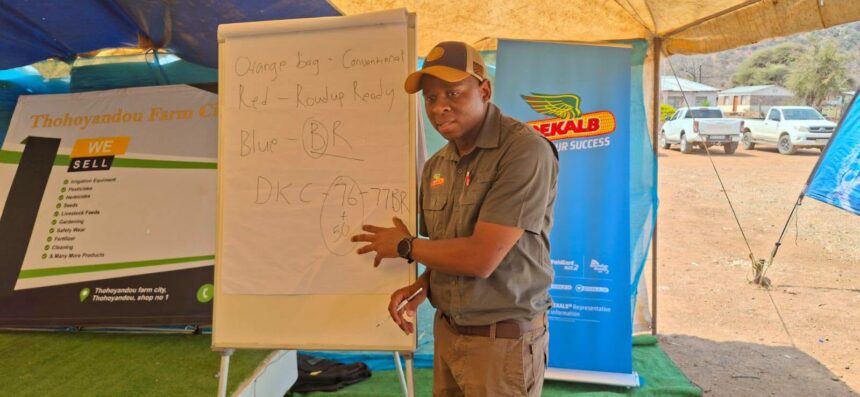
Farmers from Ward 37, covering communities from Maangani village to Smoki village, have benefited from a Maize Information Sharing Day aimed at improving maize production and strengthening practical farming knowledge. The event was held at the Khomele Garside irrigation scheme through a partnership involving the Limpopo Department of Agriculture and Rural Development, Bayer and DeKalb and Thohoyandou Farm City. New Holland Agriculture and Labery Home of Agriculture also supported the programme, bringing together agricultural experts and farmers for a practical exchange of information. The initiative focused on important aspects of maize production, including soil testing, fertiliser application, weed control, disease management and seed selection. By bringing technical knowledge directly to farmers, the programme provided an opportunity for producers to improve their farming practices and make more informed decisions throughout the maize production cycle.
Agricultural experts from Madzivhandila College of Agriculture, the Limpopo Department of Agriculture and Rural Development, Bayer and Thohoyandou Farm City shared information designed to address practical challenges faced by maize farmers. The discussions covered several stages of maize production, from preparing the soil and selecting suitable seed varieties to managing crops during the growing season. Farmers were given an opportunity to engage with specialists and learn more about practices that can influence crop health and productivity. The programme also highlighted the importance of applying agricultural knowledge in a planned and informed manner rather than relying solely on traditional practices. This type of farmer-focused engagement can help producers strengthen their technical knowledge while improving the management of their maize enterprises.
Dr Orbert Lufuno Nethononda from Madzivhandila College of Agriculture placed particular emphasis on the importance of soil testing. He encouraged farmers to test their soils and retain their soil-test results for future reference. Soil testing provides information about the nutrient status of a field and can help farmers understand the conditions in which their crops will grow. Having access to previous test results can also help farmers monitor changes in soil conditions and make more informed decisions about future production. The message was especially relevant to maize farmers because effective crop production depends on understanding soil conditions before applying fertilisers and other inputs.
Soil testing can also support the efficient and economical use of fertilisers. When farmers understand the nutrient status of their soil, they can make better-informed decisions about which nutrients may be required and how much fertiliser should be applied. This can support healthy plant growth and contribute to improved yields when combined with appropriate crop management practices. Testing can also help reduce unnecessary fertiliser applications, which can increase production costs without providing corresponding benefits to the crop. In addition, responsible nutrient management can help reduce environmental pollution associated with excessive nutrients entering surrounding soil and water systems.
Agricultural Adviser Ms Nyengedzedzeni Ratshilivha provided farmers with practical guidance on fertiliser application from planting through to harvest. Her presentation focused on the importance of managing fertiliser correctly at different stages of maize production. She also shared information about weed control and disease management, highlighting the need for farmers to use appropriate management practices for their maize crops. Weeds can compete with maize plants for water, nutrients, sunlight and space, making effective control an important part of crop management. Disease management is equally important because farmers need to monitor their crops and respond appropriately to problems that could affect plant health and production.
The programme also introduced farmers to different maize seed varieties available through DeKalb. Mr William Mothapo, representing Bayer and DeKalb, explained various seed options produced by the company and provided information that can assist farmers when considering their planting choices. Selecting suitable seed is an important part of maize production because farmers need to consider factors such as their production environment, farming conditions and intended production objectives. Mothapo also discussed weed-control chemicals available to farmers and explained their potential role in managing weeds. Access to information about seed varieties and crop protection products can help farmers make decisions based on their specific farming requirements.
The involvement of Thohoyandou Farm City and other agricultural partners added another practical dimension to the information-sharing programme. Partnerships between farmers, agricultural departments, educational institutions and private agricultural companies can create opportunities for producers to access different types of expertise. Farmers can benefit from combining scientific knowledge, practical agricultural experience and information about available farming products and technologies. Support from New Holland Agriculture and Labery Home of Agriculture further demonstrated the role that different agricultural stakeholders can play in farmer development. Such collaboration can help create stronger links between agricultural knowledge, production resources and the needs of farming communities.
The Assistant Director responsible for the Dzanani Service Centre under the Vhembe West Agricultural Ecological Zone welcomed the initiative and praised the organisers for taking agricultural knowledge directly to farmers. Her remarks highlighted the importance of ensuring that farmers have access to relevant information within their communities. Bringing experts closer to farming areas can make it easier for producers to ask questions, discuss challenges and understand how technical recommendations can be applied in their own fields. The approach also creates opportunities for agricultural institutions to better understand the experiences and needs of local farmers. Stronger communication between farmers and agricultural support services can contribute to more informed agricultural decision-making.
The Assistant Director also encouraged farmers to approach agriculture as a business rather than relying on farming only as a means of subsistence. Treating farming as a business requires producers to consider production costs, market opportunities, productivity, planning and the effective use of resources. Farmers who understand these factors can make more informed decisions about what to plant, how much to produce and how to manage their available resources. The message is particularly relevant for maize producers seeking to increase production and participate more effectively in agricultural markets. Building commercially focused farming enterprises can also contribute to local economic activity and create opportunities for rural households.
Another important message from the event focused on succession and the involvement of young people in agriculture. Farmers were encouraged to introduce younger generations to farming so that agricultural knowledge and practical experience can be passed on. Succession is important because farming communities need younger producers who can continue agricultural activities and introduce new ideas and technologies. Encouraging young people to participate in agriculture can also help change perceptions of farming as an economic activity and create opportunities for future agricultural entrepreneurs. Passing knowledge between generations can strengthen the long-term sustainability of farming communities.
The farmers welcomed the Maize Information Sharing Day and praised the initiative for bringing practical agricultural knowledge closer to them. The event gave producers from Ward 37 an opportunity to engage directly with agricultural specialists and learn about important maize production practices. Information on soil testing, fertiliser management, weed control, disease management and seed selection can provide farmers with useful tools for improving their production decisions. The participation of government, agricultural companies, educational institutions and farming support organisations also demonstrated the value of cooperation in strengthening local agriculture. Continued programmes of this nature can help ensure that farmers have access to practical knowledge that supports productive, informed and commercially focused maize farming in the communities from Maangani village to Smoki village.
Join 'Farmers Mag' WhatsApp Channel
Get the latest Farming news and tips delivered straight to your WhatsApp
CLICK HERE TO JOIN