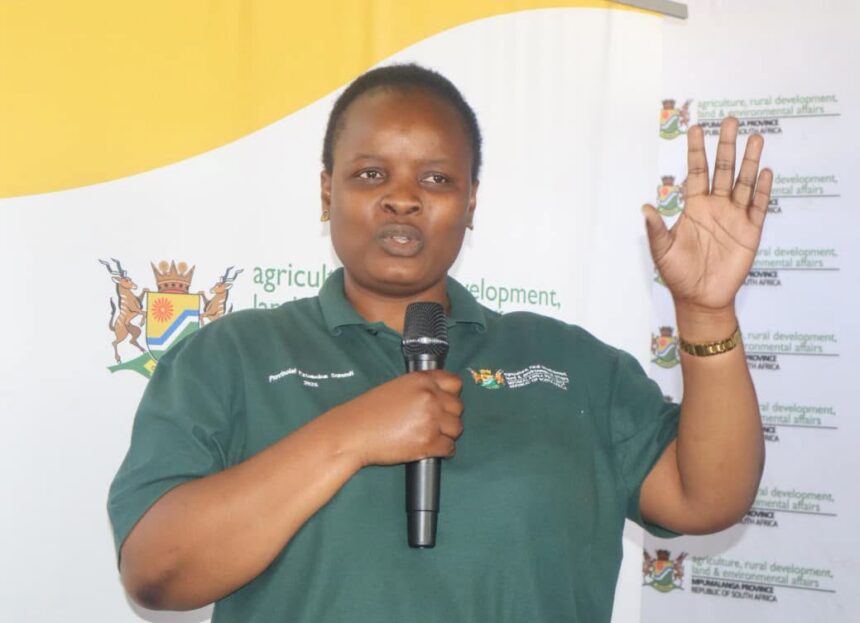
The Department of Agriculture, Rural Development, Land and Environmental Affairs and Seedlink hosted a Grain Farmers Day at Rodekraans Farm in Morgenzon under Lekwa Local Municipality. The event brought grain farmers together to strengthen their understanding of seed selection, soil management and crop production practices that can contribute to more profitable farming operations. Held under the theme “Building Profitable Farms through Better Decisions”, the programme focused on the importance of making informed choices throughout the production cycle. Farmers were encouraged to consider the specific conditions of their farms when selecting hybrids rather than relying on a one-size-fits-all approach. The engagement provided practical information aimed at helping grain producers improve their production decisions while managing their resources more effectively.
A key focus of the Grain Farmers Day was the selection of suitable maize hybrids based on environmental conditions. Farmers were advised to consider weather patterns, temperature, rainfall, location, altitude and soil fertility when deciding which hybrids to plant. These factors can influence crop development and determine how well a particular hybrid performs under specific farming conditions. Understanding the production environment allows farmers to select seed varieties that are better suited to the conditions in which they will be grown. Making these decisions before planting can help producers manage production risks and create a stronger foundation for achieving their expected yields.
Weather conditions are particularly important when planning grain production because farmers operate within changing environmental conditions. Temperature and rainfall can influence germination, crop development and the availability of water during important stages of maize growth. Farmers therefore need to understand the conditions on their farms and consider how these factors interact with the characteristics of different hybrids. Location and altitude can also influence the growing environment and should form part of the decision-making process. By assessing these conditions before selecting seed, farmers can make choices that are better aligned with their local production environment.
Soil fertility was another important factor highlighted during the engagement. The fertility of the soil affects the availability of nutrients required by maize plants to develop properly and produce grain. Farmers need accurate information about their soil before making decisions about fertiliser and other inputs. Soil testing and analysis can provide information about nutrient levels and other soil conditions that influence crop production. Using this information can help farmers avoid making input decisions based solely on assumptions and can support more efficient use of available resources.
The Grain Farmers Day placed strong emphasis on soil health, describing it as a critical foundation for achieving strong yields. Farmers were empowered with information about soil texture, soil structure and yield potential to help them understand the condition of their fields. Soil texture affects characteristics such as water movement and retention, while soil structure influences root development, drainage and the movement of air through the soil. Understanding these characteristics can help farmers identify limitations and make more informed decisions about soil management. Healthy and well-managed soil can provide a stronger growing environment for maize and support consistent crop production.
Soil testing was highlighted as an important management practice that can provide farmers with information needed to make better production decisions. A soil test can help determine the nutrient status of a field and identify issues that may limit crop performance. Farmers can use the results to guide fertiliser applications and address specific soil requirements. Regular analysis can also help producers monitor changes in soil conditions over time. This approach supports more targeted input management and can help farmers avoid unnecessary expenditure on fertilisers that may not address the actual needs of their fields.
Managing soil acidity and pH was another important part of the discussions on maize production. Soil pH influences the availability of nutrients to plants and can affect how effectively maize can access the nutrients present in the soil. When soil acidity is not properly managed, nutrient availability and plant growth can be affected. Farmers therefore need to understand the pH conditions of their fields and use soil analysis to guide appropriate management decisions. Paying attention to soil acidity can contribute to creating conditions that support healthy maize growth and more effective use of fertiliser inputs.
The theme of building profitable farms through better decisions connected the different areas discussed during the event. Profitability in grain farming depends on more than achieving high yields because farmers also need to manage input costs and make decisions based on the conditions of their farms. Seed selection, soil management and fertiliser use all have financial implications for producers. Making informed decisions can help farmers use their available resources more efficiently while reducing avoidable production risks. The event therefore encouraged farmers to view technical agricultural knowledge as an important part of running a sustainable and profitable farming business.
The engagement also demonstrated the value of collaboration between agricultural institutions, private sector partners and grain farmers. Events that bring technical experts and producers together create opportunities for farmers to ask questions and gain knowledge that can be applied directly in their fields. Seed companies and agricultural organisations can also use these engagements to better understand the practical needs of producers. Farmers benefit from access to information that can support decisions before and during the production season. Continued knowledge-sharing can contribute to stronger agricultural practices and more informed grain production across farming communities.
The Grain Farmers Day at Rodekraans Farm provided farmers in Morgenzon and the Lekwa Local Municipality with practical information focused on improving production decisions. The emphasis on environmental conditions showed the importance of selecting hybrids according to the specific characteristics of each farming area. The focus on soil health reinforced the need for farmers to understand their soil through testing, analysis and appropriate management of texture, structure, fertility and pH. These practices can help producers make better use of seed, fertiliser and other agricultural inputs while working towards stronger yields. By promoting better decisions based on local conditions and reliable soil information, the DARDLEA and Seedlink initiative is supporting farmers in building more informed, productive and commercially focused grain farming operations.
Join 'Farmers Mag' WhatsApp Channel
Get the latest Farming news and tips delivered straight to your WhatsApp
CLICK HERE TO JOIN