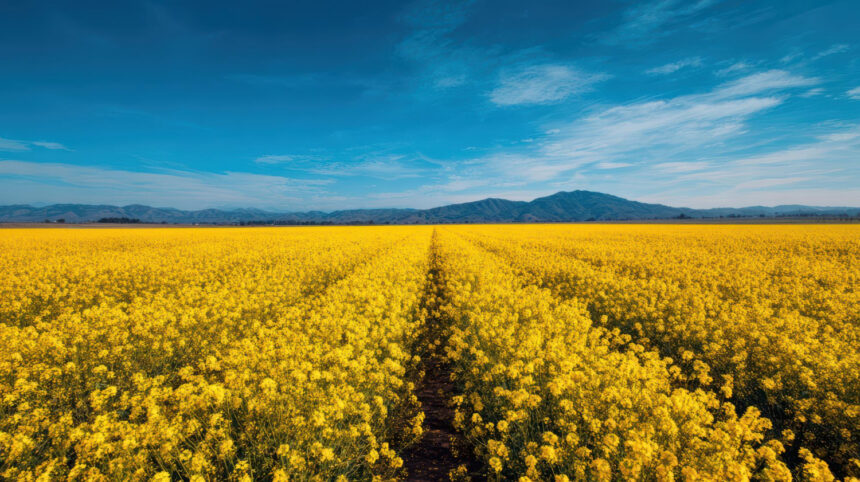
South Africa’s canola sector is undergoing a major economic transformation as the crop moves from being primarily a rotational option for grain farmers to becoming an increasingly important commercial agricultural commodity. The rapid growth in planted hectares has created new opportunities for producers, processors, input suppliers and other businesses across the agricultural value chain. Industry leaders discussed this changing landscape during the Canola: A Golden Future panel discussion at NAMPO Cape on 10 September 2026. The panel was led by Corné Louw, Head of Grain Economics and Member Services at Grain SA, alongside industry specialists Franco le Roux, Zander Spammer, Andries Theron and Piet Lombard. Their discussion highlighted the need for production growth to be supported by stronger processing capacity, market development, improved genetics, technological innovation and responsible chemical management.
The expansion of canola production in South Africa has been particularly significant in the Western Cape, where the crop has become an important part of commercial grain farming systems. National plantings stood at about 34 000 hectares in 2010, reflecting the crop’s early adoption and growing recognition among farmers. By 2020, the planted area had more than doubled to 74 120 hectares as producers increasingly recognised the rotational and economic benefits of canola. Growth accelerated sharply between 2024 and 2026, with plantings reaching 165 750 hectares in 2024, 174 515 hectares in 2025 and approximately 192 300 hectares in 2026. Around 188 000 hectares of the 2026 national total were located in the Western Cape, demonstrating the province’s dominant position in South Africa’s canola industry.
The scale of this expansion reflects improvements across several areas of agricultural production. Advances in seed technology have helped farmers access cultivars that can deliver stronger performance under local growing conditions. Precision farming equipment and improved mechanisation have also enabled producers to manage fields more efficiently while applying inputs with greater accuracy. Local research has contributed to better understanding of the crop and its production requirements, while improved crop management systems have helped farmers optimise yields. These developments have collectively helped canola become a more commercially attractive option for South African grain producers.
Canola’s role within crop rotation systems remains an important part of its appeal to farmers. The crop can provide rotational benefits while giving producers another source of income within their overall farming operations. Its growing commercial value has become particularly important during periods when grain farmers face unpredictable weather conditions and changing market prices. With approximately 98% of South Africa’s canola production concentrated in the Western Cape, the crop has become a significant component of the region’s agricultural economy. The continued increase in plantings suggests that producers see canola as more than an additional crop, with its financial performance increasingly influencing planting decisions.
The rapid growth in production is now creating a pressing need for additional processing infrastructure. As harvest volumes increase, the industry must ensure that there is sufficient capacity to process the crop efficiently and provide farmers with reliable market opportunities. One of the key developments discussed at the NAMPO Cape panel was Overberg Agri’s feasibility assessments and regulatory applications for a dedicated canola crushing facility in the Swartland. The proposed facility is targeted for 2027 and could have a significant impact on producers in the surrounding region. Local processing would reduce the distance that Swartland farmers need to transport their canola while potentially lowering logistics costs and improving supply chain efficiency.
A new crushing facility would also help strengthen the regional canola value chain by keeping more economic activity closer to production areas. Instead of transporting raw seed over long distances for processing, farmers could have access to a facility within a more convenient regional market. This could reduce pressure on transport infrastructure and create additional opportunities for businesses involved in storage, logistics, processing and distribution. Investment in crushing capacity would also send an important signal about private sector confidence in the future of the industry. If production continues to increase, additional processing infrastructure could become essential to preventing bottlenecks and ensuring that the sector can sustain its growth.
Market development will be equally important as South Africa produces increasing volumes of canola. Industry leaders stressed that production cannot expand indefinitely without corresponding growth in processing capacity and demand. Developing structured export channels will therefore remain important, particularly when domestic production exceeds local demand. Exports can provide farmers and processors with access to international markets and create an additional outlet for surplus seed. At the same time, the industry needs to ensure that South Africa captures as much domestic value from the crop as possible instead of relying heavily on the export of unprocessed agricultural commodities.
Local processing can help achieve greater value retention by converting raw canola seed into products such as canola oil and high-protein meal. Canola oil has established uses in food production, while the protein-rich meal provides an important opportunity within the animal feed market. Industry growth could therefore extend beyond crop production if more canola meal is incorporated into feed for poultry, dairy and livestock operations. Increasing domestic demand for canola meal could create a stronger connection between crop farmers and the country’s animal production industries. This would help develop a more integrated agricultural value chain in which different sectors benefit from the expansion of canola production.
Genetics and plant breeding will also play an important role in determining whether the sector can maintain its growth trajectory. Farmers need access to cultivars that can deliver reliable yields while coping with the environmental and disease pressures associated with local production conditions. Advances in plant genetics have already contributed to improved yields, drought tolerance and disease resilience. Continued investment in research and development will be necessary as producers face changing climatic conditions and evolving production challenges. Better genetics can help farmers improve productivity while also supporting the broader competitiveness of South African canola.
Technology must also be combined with responsible agricultural stewardship. As production expands, farmers need to manage agrochemicals carefully to protect crop performance and maintain the long-term effectiveness of available products. Poor chemical management can contribute to weed resistance and create additional production challenges for farmers. Strict adherence to application requirements is also important because international markets have specific food safety standards and residue limits. Maintaining high standards of chemical stewardship can therefore protect both agricultural productivity and South Africa’s ability to access valuable export markets.
The industry’s future will depend on maintaining cooperation between the different participants in the canola value chain. Producers need reliable access to seed, technology, inputs, research and markets, while processors require sufficient volumes of quality canola to justify continued investment. Researchers and seed companies have an important role in developing varieties that respond to local conditions, while marketers need to expand demand in both domestic and international markets. Government and industry organisations can also support an environment that encourages investment and responsible growth. Strong coordination will be necessary to ensure that production expansion does not outpace the infrastructure and markets required to support it.
The discussions at NAMPO Cape show that South Africa’s canola industry has reached an important stage in its development. What began as a crop valued largely for its role in rotation systems has become a major commercial opportunity with growing production, increasing private investment and significant potential for domestic value addition. The expansion to approximately 192 300 hectares in 2026 demonstrates the scale of the industry’s progress, while planned processing investment in the Swartland points to growing confidence in its future. Sustaining this momentum will require continued investment in genetics, processing, markets, technology and responsible chemical use. If producers and industry partners continue developing the full value chain alongside farm-level production, canola can strengthen its position as an important contributor to South Africa’s agricultural economy and create further opportunities for farmers, processors and rural communities.
Join 'Farmers Mag' WhatsApp Channel
Get the latest Farming news and tips delivered straight to your WhatsApp
CLICK HERE TO JOIN