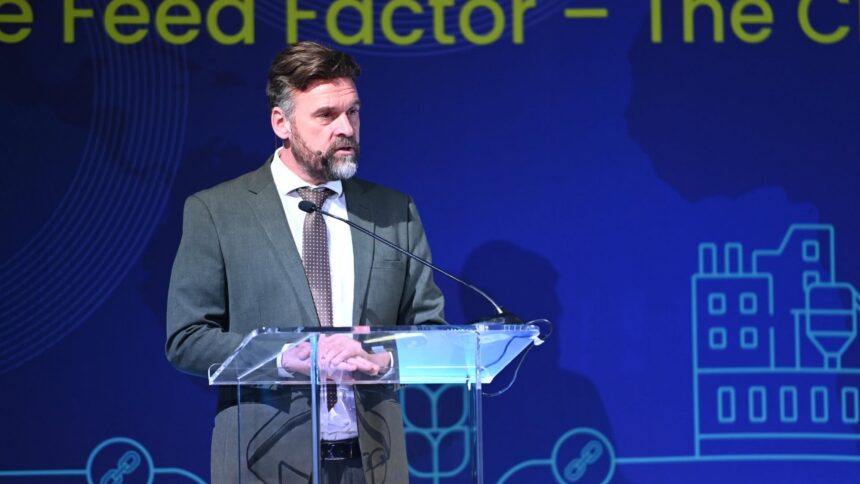
Animal feed manufacturing is entering a period of significant change, and growth alone will not be enough to secure the industry’s future. Manufacturers will need to improve productivity, strengthen product quality, develop new skills and connect more effectively with every part of the agricultural value chain. These changes are being driven by advances in artificial intelligence, digitalisation, automation, integrated planning and new approaches to sustainability. At AFMA Forum 2026, keynote speaker Prof Henrik von Scheel, an Industry 4.0 originator and strategic intelligence expert, outlined the major trends that could shape animal feed manufacturing over the next decade. His message was clear, the sector has significant growth potential, but businesses will need to become smarter and more connected if they want to remain competitive.
Prof von Scheel described animal feed manufacturing as one of the key growth industries globally and in South Africa. His presentation focused on strategic intelligence and the trends that are expected to influence the industry during the next 10 years. He grouped the future outlook around three broad areas, growth, productivity and quality. Growth creates opportunities for manufacturers to expand their businesses and serve increasing demand, while productivity focuses on operational excellence and the ability to produce more effectively. Quality remains equally important because the performance of animal feed directly affects the animals that consume it and the wider agricultural systems that depend on successful livestock production.
One of the most important changes facing manufacturers is the need to focus on the performance of the finished product rather than looking only at individual ingredients or components. Feed manufacturers operate in a complex environment where the interaction between ingredients, formulation, processing and animal requirements influences the final outcome. A stronger focus on product performance can help businesses assess whether their feed delivers the results expected by farmers and other customers. This approach shifts attention towards measurable outcomes rather than treating individual components as separate priorities. It can also encourage manufacturers to invest more heavily in research, formulation expertise and technologies that improve the consistency and effectiveness of their products.
Feed additives are another major strategic consideration for the industry. Additives can serve different functions in animal nutrition and can become increasingly important as manufacturers seek to improve feed performance and respond to changing production requirements. The growing focus on additives also creates opportunities for research and innovation within feed formulation. Manufacturers will need to understand how different additives contribute to feed quality, animal performance and production efficiency. As this area develops, businesses that can combine scientific knowledge with effective product development may gain an advantage in an increasingly competitive market.
Operational excellence will also become central to the industry’s ability to grow efficiently. Traditional manufacturing systems are being transformed by digital technologies, artificial intelligence and automation. Prof von Scheel highlighted the emergence of new forms of operational excellence in which technology can help manufacturers sense, monitor and automate feed production processes. These systems can improve the way plants collect and use information while helping managers identify inefficiencies and respond more quickly to operational problems. The shift towards digital manufacturing means that feed producers will increasingly need to understand both production processes and the technologies that can make those processes more efficient.
Artificial intelligence could become particularly important as manufacturers collect increasing amounts of operational data. AI systems can help businesses analyse information, identify patterns and support decision-making across production and supply chain activities. Manufacturers could use these capabilities to improve planning, monitor equipment performance, manage production processes and identify opportunities to reduce waste. However, adopting AI successfully will require more than purchasing new technology because companies will also need employees who understand how to use these systems effectively. The real value of AI will come from integrating it into business processes and using it to support better decisions.
Integrated business planning is another area where major changes are expected. Many manufacturers already use integrated planning processes to coordinate different parts of their businesses, but these systems can increasingly be connected with day-to-day operations. Greater integration can help businesses align production with demand, inventory, procurement, financial planning and other operational requirements. This can improve visibility across the organisation and help manufacturers respond more effectively when market conditions change. Connecting strategic plans with operational activity can also reduce the gap between what a business intends to achieve and what happens on the factory floor.
Bioeconomics will also influence the future of animal feed manufacturing as businesses look more closely at how resources can be used across the agricultural value chain. This approach encourages manufacturers and other participants to consider the economic value of biological resources while looking for more efficient ways to use available materials. The concept can influence decisions about raw materials, waste, by-products and production processes. It also connects feed manufacturing to broader discussions about resource efficiency and sustainable agricultural production. Manufacturers that understand these connections may be better positioned to identify new opportunities while responding to growing pressure for more responsible use of resources.
Traceability and safety will become increasingly important as the industry becomes more connected. Feed moves through a complex value chain involving suppliers, manufacturers, distributors, farmers and ultimately animals that enter the food production system. Strong traceability systems can help businesses track materials and processes while improving their ability to identify the source of problems. Safety systems are equally important because feed quality can affect animal health and the integrity of the wider food chain. A more connected value chain can therefore strengthen transparency and accountability while helping businesses respond more effectively to quality or safety concerns.
Prof von Scheel also emphasised that the future of animal feed manufacturing depends on connecting the value chain from beginning to end. Manufacturers need to understand where their feed comes from, how raw materials move through production and who ultimately consumes the finished product. Better connections between these stages can improve information sharing and create opportunities for more efficient planning. Stronger relationships between manufacturers, suppliers, farmers and other stakeholders can also encourage innovation and allow the industry to respond more effectively to changing needs. The future feed manufacturing business will therefore need to look beyond its own factory and understand its position within the wider agricultural ecosystem.
Skills development will be critical as these changes take place. The industry faces a shortage of training in some areas, while employees are increasingly expected to manage responsibilities that require new technical and digital capabilities. Prof von Scheel raised the risk of the Peter Principle, where people can be promoted into positions without receiving the skills needed to succeed in their new responsibilities. A plant manager, for example, may suddenly be expected to oversee AI projects, digital transformation and project management while still carrying the responsibilities of running the plant. Industry-wide training and professional development can help employees build the skills required to manage these expanding responsibilities effectively.
This creates an important opportunity for AFMA to strengthen its role as a central support structure for the animal feed industry. Prof von Scheel highlighted AFMA’s long history and described the organisation as an important pillar as the sector faces an increasingly uncertain future. AFMA can support the industry by aligning best practices, encouraging innovation, providing training and representing manufacturers in discussions with government. It can also help businesses understand regulatory and compliance requirements while contributing to conversations about industrial policies that could shape the sector over the next five to 10 years. A strong industry organisation can provide businesses with access to knowledge, resources and collective expertise that may be difficult for individual companies to develop on their own.
Innovation in areas such as financing could also become part of AFMA’s evolving role. Prof von Scheel pointed to inventory financing as an example of an area where new models could potentially support manufacturers facing financial constraints. As an industry grows, companies may require greater working capital to manage inventory, expand production and respond to market opportunities. New financing approaches could help businesses overcome some of these limitations when traditional funding does not adequately meet their needs. Industry organisations can contribute by bringing stakeholders together, identifying common challenges and supporting the development of practical models that benefit the sector.
Prof von Scheel’s description of AFMA as a “mother hen” also illustrates the organisation’s potential role during periods of uncertainty. The idea is that individual companies can operate independently when conditions are stable, while the industry organisation provides support when businesses face difficult circumstances. This support can include education, regulatory guidance, knowledge sharing, access to resources and opportunities to exchange ideas. Such a role can help manufacturers respond collectively to challenges while continuing to compete individually in the market. It also reinforces the importance of having a stable industry body that can represent shared interests while supporting innovation and growth.
The competitive environment will become more demanding as animal feed manufacturing expands. Growth attracts new competitors and creates pressure for existing businesses to improve their performance. Manufacturers will need to compete not only with other companies but also against inefficiencies within their own operations. This makes investment in technology, skills, quality systems and integrated planning increasingly important. Businesses that understand their strengths and weaknesses and use data to improve decision-making will be better positioned to respond to changing market conditions.
AFMA Forum 2026 has highlighted that the future of animal feed manufacturing will depend on much more than increasing production volumes. Prof Henrik von Scheel’s six strategic imperatives, covering product performance, feed additives, operational excellence, integrated planning, bioeconomics, traceability and safety, provide a broad framework for navigating the next decade. At the same time, AFMA’s role in supporting best practices, innovation, skills development and industry representation could become increasingly important as manufacturers face technological, regulatory and competitive pressures. The sector has strong growth potential, but that potential will depend on whether businesses develop smarter operations, stronger skills and deeper connections across the value chain. A more capable and coordinated industry can improve productivity and quality while positioning South Africa’s animal feed manufacturing sector to compete and grow in an increasingly complex global market.
Join 'Farmers Mag' WhatsApp Channel
Get the latest Farming news and tips delivered straight to your WhatsApp
CLICK HERE TO JOIN