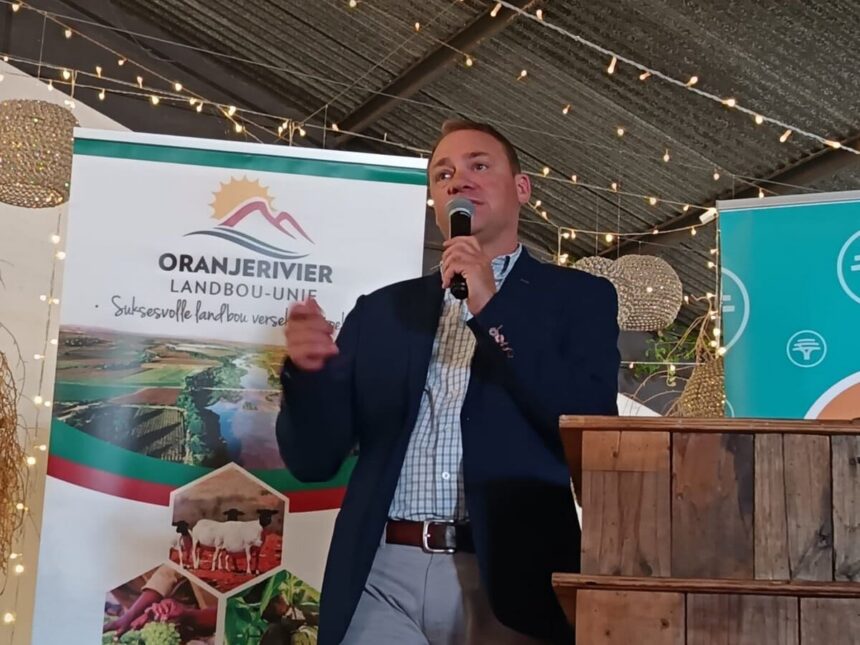
South African farmers are facing a growing combination of challenges that is putting pressure on farm profitability, productivity and long-term sustainability. Foot-and-mouth disease (FMD), rising input costs and increasing labour expenses are among the issues requiring coordinated responses from the agricultural sector. Agri SA president Willem de Chavonnes Vrugt and Agriculture Gauteng president Konrad Burger have therefore called for greater unity within organised agriculture. Speaking at Agriculture Gauteng’s annual congress and AGM at Obaro Silverlakes in Pretoria, the two leaders argued that farmers have greater influence when they work through strong collective structures. Their message was clear: individual farmers remain important, but many of the decisions affecting agriculture require a unified industry voice supported by credible information and reliable data.
De Chavonnes Vrugt used the example of a rope to explain why cooperation between farmers, commodity organisations and provincial agricultural structures matters. He pointed out that a rope can contain more than 50 000 individual fibres and does not depend on a single central core for its strength. Each fibre contributes to the overall structure, with the interaction between the fibres helping create a stronger whole. He compared this structure to organised agriculture, where individual farmers represent individual strands while commodity organisations and provincial unions add further strength. The comparison highlights how farmers can retain their independence while still benefiting from coordinated representation when addressing issues that affect the wider agricultural sector.
The economic importance of agriculture makes this collective representation particularly significant. According to figures presented at the congress, the agricultural sector generated R266 billion in exports during 2025 and recorded a trade surplus of R124 billion. Agriculture also employed about 950 000 people, while the broader agricultural value chain contributed approximately 15.4% to the country’s gross domestic product. These figures demonstrate that agriculture has an impact that extends well beyond individual farms and rural communities. Decisions affecting the sector can influence employment, exports, food supply, manufacturing, logistics and numerous businesses connected to agricultural production.
De Chavonnes Vrugt argued that farmers and their representative organisations need to understand how decisions are made at different levels of the agricultural system. Some decisions begin at farm level, while others are shaped by commodity organisations, provincial structures, regulators and national government. Effective representation requires these different levels to communicate and coordinate rather than operating separately. A farmer may understand the challenges facing a particular operation, while an industry organisation can combine information from hundreds or thousands of producers to demonstrate a broader trend. This coordination can give policymakers a clearer picture of how regulations, tariffs, disease controls and economic decisions affect agricultural businesses on the ground.
The importance of reliable data was another major focus of the discussion. De Chavonnes Vrugt stressed that unity by itself does not guarantee influence, particularly when farmers are engaging regulators and government institutions. Agricultural organisations need credible evidence to demonstrate the real effects of policy decisions on farming businesses. Data collected directly from producers can help reveal costs and operational pressures that may not be visible in national or industry-level statistics. When agricultural representatives can support their arguments with accurate information, they have a stronger basis for negotiating changes and influencing future decisions.
Electricity tariffs provided a clear example of how farm-level data can strengthen agricultural advocacy. NERSA approved a 12.74% Eskom tariff increase for 2024, but Agri SA found that the actual impact on some farmers, particularly irrigation farmers, was closer to 30%. The difference highlighted the importance of understanding how agricultural electricity consumption differs from that of other users. Agri SA gathered information from farmers across different commodities and provinces and used the data to demonstrate the farm-level impact to the regulator. Although the approved increase could not be reversed, the engagement helped influence how NERSA and Eskom would consider agricultural electricity consumption in future tariff discussions.
The electricity example demonstrates why farmers should participate in efforts to improve agricultural data collection. A representative organisation can make a stronger case when it has accurate information showing how a policy affects producers in different regions and farming sectors. Without sufficient data, agricultural organisations may struggle to quantify the financial impact of regulations or economic changes. This can make it more difficult to convince policymakers that a particular decision requires reconsideration or a different approach. Agri SA’s work to strengthen its agricultural database, including through its AgriSpoor application, is therefore aimed at improving the industry’s ability to use evidence when engaging decision-makers.
Konrad Burger focused more closely on the challenges farmers experience at operational level. He identified FMD, labour costs and rising input expenses among the major pressures currently facing producers. These challenges can occur simultaneously, leaving farmers with limited room to absorb additional costs or disruptions. FMD can affect livestock movement and market access, while higher fertiliser, fuel and equipment prices increase the cost of producing crops and livestock. Rising labour costs add another financial consideration, particularly for farming operations that depend heavily on human labour.
The FMD challenge demonstrates why collective representation remains important. Individual farmers have limited ability to influence the availability of vaccines, livestock movement policies or the broader government response to disease outbreaks. Burger noted that one farmer cannot negotiate access to vaccines globally or independently engage government services to manage livestock movements across affected areas. A farmers’ organisation representing a large number of producers can present a stronger case when engaging authorities and other stakeholders. Collective action can therefore help ensure that the practical challenges experienced on farms receive greater attention when disease control policies are developed and implemented.
Livestock movement controls are particularly important in the management of FMD because animal movement can contribute to the spread of the disease. Restrictions can affect farmers who need to transport animals for sales, breeding, slaughter or other legitimate agricultural purposes. At the same time, authorities must balance the economic needs of farmers with the need to contain disease and protect the broader livestock industry. Finding that balance requires communication between government and producers who understand the practical realities of livestock farming. Organised agriculture can provide a channel through which farmers’ experiences and concerns reach policymakers while also helping producers understand and comply with disease control measures.
Labour costs represent another complex issue for South African agriculture. Burger acknowledged the importance of ensuring that farmworkers receive dignified remuneration while also pointing to the challenge of maintaining productive and financially sustainable farming businesses. Higher wage costs can affect different farming operations in different ways depending on the level of mechanisation, crop type, production model and labour requirements. Farmers may need to consider mechanisation, productivity improvements and changes to production systems as labour expenses increase. Policymakers also need to understand these differences when considering labour-related decisions that could affect agricultural businesses and rural employment.
Rising input costs create another layer of pressure for producers. Fertiliser, fuel, machinery and other agricultural inputs have become significant components of farm budgets, while the prices farmers receive for their products do not always increase at the same rate. This creates a difficult financial environment in which producers must manage higher production expenses while maintaining competitive prices. Individual farmers have limited power to influence many of these broader market conditions. Collective organisations can help by representing producers in policy discussions, advocating for improved conditions and providing data that demonstrates how cost increases affect different agricultural sectors.
Burger encouraged farmers to view membership of organised agriculture as an investment rather than simply a subscription expense. The argument is based on the idea that farmers contribute to structures that represent their interests when decisions are made at provincial, national and regulatory levels. A farmer can continue making independent decisions about their own business while also participating in a collective effort to address challenges that cannot be solved at farm level. This approach can strengthen the connection between individual producers and the organisations representing them. Stronger participation also gives agricultural organisations access to more information and a broader understanding of the challenges facing producers.
The call for unity does not mean that all farmers face identical circumstances or have exactly the same priorities. Crop producers, livestock farmers, irrigation operations and smaller agricultural businesses can experience policy and economic changes differently. Effective organised agriculture must therefore create space for these different experiences while identifying issues that affect the sector broadly. Credible data can help achieve this because information from different commodities and provinces can show where challenges overlap and where specific interventions may be required. Combining diverse perspectives with reliable evidence can make the agricultural sector’s engagement with government more informed and constructive.
The message from the Agriculture Gauteng congress comes at a time when South African agriculture needs strong representation on several fronts. FMD continues to create challenges for livestock producers, while rising production costs and labour pressures affect the financial sustainability of farming businesses. At the same time, agriculture remains a major contributor to exports, employment and the broader economy. These realities create a need for farmers to participate in structures capable of representing their interests while also providing policymakers with accurate information. Greater cooperation between individual farmers, commodity organisations and provincial and national structures could help the sector respond more effectively to challenges that extend beyond individual farms.
De Chavonnes Vrugt and Burger ultimately presented different aspects of the same argument. Farmers need collective strength to address issues that are too large or complex for individual producers to resolve on their own. That collective strength becomes more effective when organisations have accurate information showing what is happening at farm level and how policies affect producers in practice. FMD, labour costs, electricity tariffs and rising input expenses all demonstrate the value of coordinated engagement backed by evidence. As South African agriculture navigates these pressures, stronger unity and better data could give farmers a more credible and influential voice in the decisions shaping the future of the sector.
Join 'Farmers Mag' WhatsApp Channel
Get the latest Farming news and tips delivered straight to your WhatsApp
CLICK HERE TO JOIN