
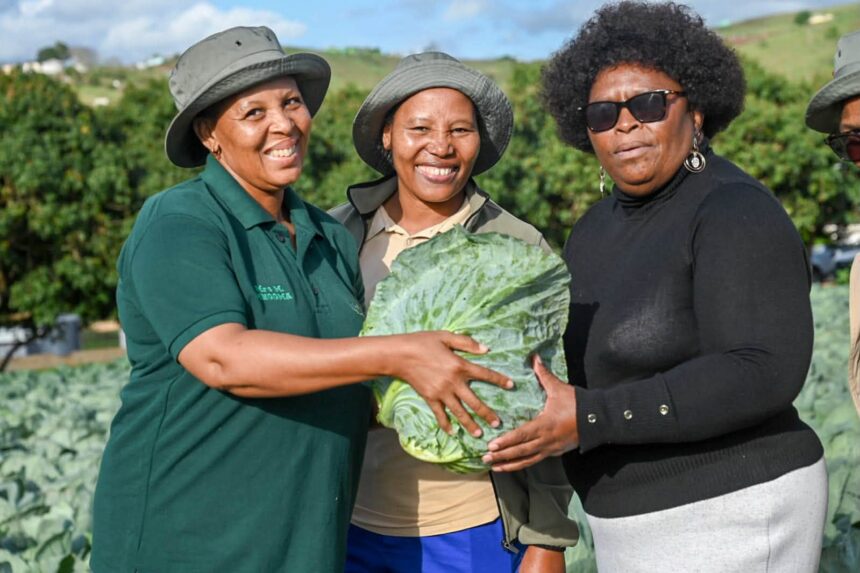
A five-women-led agricultural enterprise in the mountainous valleys of Ncazuka is demonstrating how productive farming can create food, employment and income in rural KwaZulu-Natal. Sivusasizwe Primary Co-operative, a 100% female-owned crop production enterprise, has expanded its operations to produce a range of fresh vegetables for growing customer demand. The cooperative has employed 31 women and 14 seasonal workers, creating economic opportunities through agricultural production. Its fields, where crops such as cabbage and spinach are grown across steep terrain, provide a visible example of how underused land can be turned into productive agricultural space. The progress of Sivusasizwe also reflects the broader goal of strengthening food security while supporting sustainable agricultural businesses in communities such as Ncazuka under uMdoni Local Municipality.
The significance of the cooperative was highlighted during an Oversight Visit by KwaZulu-Natal MEC for Agriculture and Rural Development, Mrs Thembeni kaMadlopha-Mthethwa. During the visit, the MEC reflected on the provincial government’s food security and agricultural development priorities. She said that KwaZulu-Natal Premier Hon. Thamsanqa Ntuli would have been proud to see his mandate being realised in the mountainous valleys of Ncazuka. Her remarks placed the cooperative’s achievements within the wider objective of supporting agriculture as a source of food and income. The visit also provided an opportunity to assess the progress of the agricultural enterprise and engage directly with its members.
Sivusasizwe Primary Co-operative’s development is significant because the enterprise is fully owned by women. Female ownership gives the cooperative a strong role in demonstrating how women can participate in agricultural production, enterprise development and rural economic activity. The cooperative’s growth shows that women-led farming enterprises can operate across a range of fresh produce categories when they have access to productive land, markets and appropriate support. Its expansion has also created employment beyond its five women leaders. The combination of ownership, production and employment gives the cooperative a wider economic role within the local community.
The agricultural activity at Sivusasizwe is particularly notable because of the area’s mountainous landscape. The fields stretch from the brow of the valleys towards their lower areas, creating a striking agricultural scene across land that might otherwise remain underused. Growing vegetables on such terrain requires careful planning and consistent management. The cooperative has demonstrated its ability to use the available agricultural potential to produce fresh food for the market. The sight of cabbages, spinach and other vegetables growing across the landscape reflects the practical connection between land, farming and rural livelihoods.
The cooperative has expanded its production in response to the potential of the farm and increasing demand from customers. Its current range of fresh produce includes cabbage, spinach, green pepper, butternut, tomatoes and potatoes. Producing several types of vegetables allows the enterprise to participate in different areas of the fresh produce market. It also demonstrates the importance of adapting production to customer requirements rather than focusing on a single crop. The ability to supply a diverse range of fresh produce can help an agricultural enterprise build stronger relationships with buyers and manage its production activities according to market opportunities.
Supplying major retailers represents an important part of the cooperative’s agricultural business activities. Access to established markets can provide farmers with opportunities to sell larger volumes of produce and build commercial relationships. However, supplying formal markets also requires farmers to maintain consistent production and meet the requirements of buyers. This makes planning, crop management, harvesting and post-harvest handling important components of the farming business. Sivusasizwe’s engagement with major retailers demonstrates the potential for rural agricultural enterprises to participate in formal food supply chains.
The employment created by Sivusasizwe adds another important dimension to its contribution to the local economy. The cooperative has employed 31 women as well as 14 seasonal workers. These employment opportunities show how agricultural production can generate income beyond the owners of a farming enterprise. Seasonal workers can also gain experience through participation in crop production activities, although seasonal employment naturally depends on the needs and production cycles of the farm. The cooperative’s workforce therefore represents an important part of the economic activity generated through its agricultural operations.
Food security remains a central concern for communities and governments because reliable access to food depends on productive and sustainable agricultural systems. Local agricultural enterprises can contribute by producing fresh food close to communities and by participating in wider food distribution networks. Vegetables such as cabbage, spinach, tomatoes, potatoes and butternut form part of everyday food consumption and have established markets. Increasing local production can contribute to the availability of fresh produce while also creating opportunities for farmers to generate income. The Sivusasizwe example shows how food production and economic development can exist within the same agricultural enterprise.
The cooperative’s progress also illustrates why agricultural support needs to focus on long-term business sustainability. Providing assistance to farmers is important, but agricultural interventions must ultimately help enterprises develop the capacity to continue operating and generating income. This requires attention to production, markets, management, infrastructure and financial sustainability. During the oversight visit, MEC kaMadlopha-Mthethwa emphasised the importance of ensuring that agricultural interventions translate into sustainable agricultural businesses. Her message highlights the need to measure agricultural support not only by immediate outputs but also by the ability of farmers to maintain viable enterprises over time.
The oversight visit also created an opportunity for the Department and the cooperative’s members to engage directly. Members welcomed the MEC’s visit and expressed appreciation for the Department’s continued support. Direct engagement can help government understand the practical realities experienced by agricultural enterprises. It can also give farmers an opportunity to communicate their experiences, needs and progress. Such interaction is important when agricultural programmes are designed to support real farming conditions rather than relying only on administrative information.
Women-led agricultural development can have wider social and economic benefits in rural communities. When women own and operate productive enterprises, agricultural income can contribute to household and community economic activity. Employment opportunities can also provide additional sources of income for workers. The cooperative’s female ownership therefore has significance beyond the management structure of the business. It forms part of a broader effort to create opportunities for women to participate meaningfully in the agricultural economy.
The experience of Sivusasizwe also highlights the importance of matching agricultural production with market demand. Farmers need to understand what customers want, how much they are likely to buy and what standards they expect. Production decisions made without consideration of the market can create challenges when farmers struggle to sell their crops at sustainable prices. By expanding its range of vegetables in response to customer demand, Sivusasizwe has demonstrated the importance of connecting farming decisions with commercial opportunities. Market-oriented production can help rural farmers move from subsistence-focused activities towards stronger agricultural enterprises.
The diversity of crops produced by the cooperative can also support agricultural planning across different production cycles. Cabbage, spinach, green pepper, butternut, tomatoes and potatoes have different production requirements and harvesting patterns. Managing several crops requires careful coordination of land, labour, inputs and harvesting activities. It also requires farmers to understand the production conditions associated with each crop. This level of management is essential for an enterprise that supplies commercial customers and aims to maintain consistent production.
The Ncazuka agricultural development story is also relevant to rural land use. Underused agricultural land represents an opportunity when communities and farmers can develop it responsibly for productive purposes. Turning such land into productive fields can contribute to food production and create economic activity. At the same time, farming on steep or mountainous terrain requires responsible land management to protect soil and maintain the productive capacity of the land. Sustainable agricultural practices are therefore important as the cooperative continues to expand.
The Department’s continued support provides an important institutional connection between the cooperative and government agricultural development programmes. Government support can help farmers address challenges that may be difficult to overcome through individual resources alone. However, sustainable farming also depends on the management decisions and commitment of the farmers themselves. The Sivusasizwe example demonstrates the importance of combining support with active participation by agricultural entrepreneurs. Strong partnerships can create conditions in which farmers have a better opportunity to build productive and commercially viable businesses.
MEC kaMadlopha-Mthethwa’s emphasis on sustainable agricultural businesses is particularly relevant as agriculture continues to play a role in rural economic development. Farmers need to operate enterprises that can generate income, maintain production and respond to changing market conditions. This means that agricultural development must consider the entire farming business, from production and labour to marketing and customer relationships. Food security and income generation should not be treated as separate objectives when productive farms can contribute to both. Sivusasizwe provides a practical example of how these goals can be connected through commercial crop production.
The cooperative’s progress also provides a positive example of agricultural participation by women in KwaZulu-Natal. Its five women leaders have developed an enterprise that produces multiple crops and supplies major retailers. The employment of 31 women and 14 seasonal workers further expands the cooperative’s contribution to the local economy. While continued growth will depend on production conditions, markets and effective business management, the current progress demonstrates the economic activity that can emerge from rural agricultural enterprises. The cooperative’s story adds to the broader discussion about women’s participation in farming and rural economic development.
The oversight visit to Sivusasizwe Primary Co-operative demonstrates why government engagement with farmers remains important. The visit allowed MEC kaMadlopha-Mthethwa to see the agricultural operation and interact with the people responsible for its development. It also provided an opportunity to reinforce the importance of turning agricultural support into sustainable businesses. For the cooperative, the engagement offered recognition of its work and an opportunity to strengthen its relationship with the Department. For the broader community, the farm represents an example of how agriculture can create food and employment from available land.
The story emerging from Ncazuka is ultimately about the relationship between women, agriculture, food security and rural income. Sivusasizwe Primary Co-operative has used its agricultural potential to produce cabbage, spinach, green pepper, butternut, tomatoes and potatoes while supplying major retailers. Its 100% female ownership and employment opportunities demonstrate the role that women-led enterprises can play in rural economic activity. The cooperative’s progress also reinforces the importance of government support that focuses on lasting agricultural businesses rather than short-term interventions. As the fields of uMdoni continue to produce fresh vegetables, Sivusasizwe stands as a clear example of how committed farmers, productive land, market opportunities and sustained agricultural support can contribute to food security and income in rural KwaZulu-Natal.
Join 'Farmers Mag' WhatsApp Channel
Get the latest Farming news and tips delivered straight to your WhatsApp
CLICK HERE TO JOIN