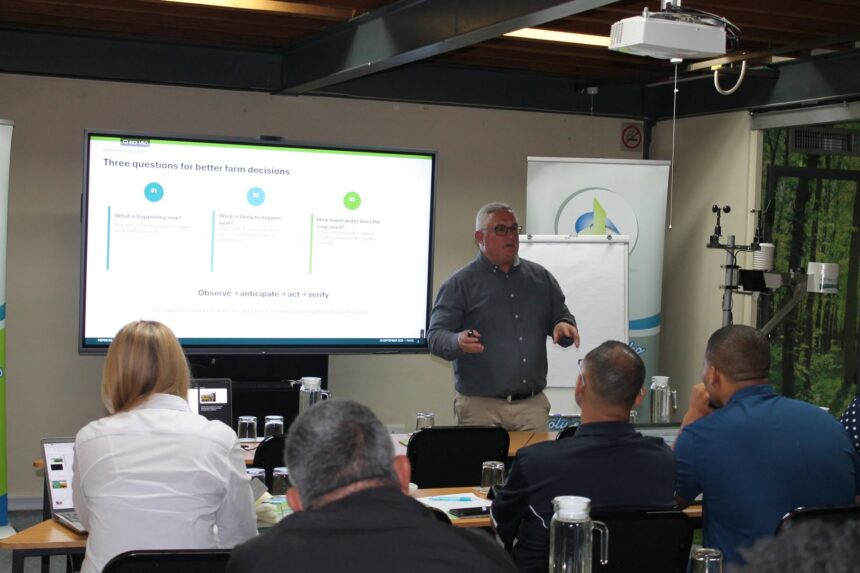
Access to accurate and timely weather information is becoming increasingly important for farmers who need to make informed decisions about irrigation, crop protection and daily farm operations. Casidra, together with Pessl Instruments South Africa, METOS and Regional Weather Reports, hosted a Weather Station Awareness Workshop at the Casidra head office in Paarl on 29 September 2026. The workshop focused on how real-time weather observations and weather forecasts can support smarter farming practices. Participants explored practical applications of weather station technology and discussed how better access to weather information can improve agricultural planning and resource efficiency. The event highlighted the growing importance of digital weather tools in helping farmers respond to changing conditions while supporting more sustainable agricultural practices.
Weather stations can provide farmers with detailed information about conditions at or near their farms. Depending on the technology and sensors used, these systems can monitor factors such as temperature, rainfall, humidity, wind conditions and other weather-related measurements. This information can give farmers a clearer picture of what is happening in their immediate production environment. Local weather observations can be especially useful because conditions can vary between locations, even within the same broader agricultural region. By combining observations from weather stations with forecasts, farmers can develop a more informed understanding of current and expected conditions.
The Weather Station Awareness Workshop provided an opportunity for participants to learn how these technologies can be incorporated into everyday farming decisions. Rather than treating weather information as general background data, farmers can use it as part of operational planning. Information about rainfall, temperature and other conditions can influence decisions about irrigation, crop protection and farm activities. Forecasts can also help farmers anticipate conditions that may affect field operations. The value of the technology therefore comes from how effectively farmers use the information to support practical decisions.
Irrigation scheduling was one of the important areas explored during the workshop. Water management is a major consideration in agriculture, particularly in areas where water resources are limited or where farmers need to manage irrigation costs carefully. Weather information can help farmers understand conditions that influence crop water requirements. Rainfall measurements and forecasts can provide additional information when farmers plan irrigation activities. More informed scheduling can help reduce unnecessary water use while ensuring that crops receive appropriate water when needed.
Efficient irrigation can also contribute to broader agricultural sustainability. Applying water according to crop needs and prevailing conditions can reduce wastage and improve the efficiency of irrigation systems. Weather data can support this process by providing information that farmers can use alongside soil conditions, crop development and irrigation system performance. However, weather information works best when farmers interpret it in the context of their own production systems. The workshop therefore focused on practical knowledge that can help participants understand how weather technology fits into wider farm management.
Crop protection is another area where accurate weather information can support better decision-making. Weather conditions can influence the development and spread of certain crop diseases and affect how agricultural treatments perform. Farmers need to consider conditions such as temperature, humidity, wind and rainfall when planning crop protection activities. Timely weather information can help farmers identify periods when conditions may be more suitable for particular operations. Using this information carefully can support more targeted crop management and reduce unnecessary applications.
Weather forecasts also have an important role in agricultural planning. A forecast can give farmers advance information about expected conditions, allowing them to plan activities around likely weather patterns. Farmers may use this information when considering irrigation, spraying, harvesting, planting or other field operations. Forecasts are not guarantees, and actual conditions can differ from predictions. Farmers therefore need to combine forecasts with real-time observations and their own knowledge of local conditions.
The combination of real-time weather data and forecasts was a central theme of the workshop. Real-time data tells farmers what conditions are currently being recorded, while forecasts provide information about what may happen in the coming period. Using both types of information can provide a more complete picture for decision-making. For example, a farmer can compare current rainfall and temperature readings with an upcoming forecast when planning irrigation or other field activities. This combination can help farmers respond to changing conditions instead of relying solely on fixed schedules.
Weather station technology can also contribute to better record keeping on farms. Regular weather measurements create a historical record that farmers can use when reviewing production conditions over time. These records may help farmers identify patterns and compare weather conditions across different production periods. Historical information can also support planning and discussions about farm management decisions. The usefulness of these records depends on the quality of the equipment, data collection and interpretation.
The workshop brought together organisations with expertise in weather monitoring and agricultural technology. Casidra hosted the event at its head office in Paarl, while Pessl Instruments South Africa, METOS and Regional Weather Reports contributed to the awareness programme. Their involvement created a platform for participants to learn more about weather station systems and their agricultural applications. The focus on practical use allowed the discussion to move beyond the technology itself and towards how farmers can apply weather information. This connection between technology and everyday farm decisions is important for making digital agricultural tools useful in practice.
For farmers, technology adoption is most valuable when it addresses a specific operational need. A weather station is not simply a device that records weather conditions. Its value depends on whether the information reaches farmers in a useful form and whether they can apply it to decisions on the farm. Training and awareness can help farmers understand what different measurements mean and how they relate to irrigation, crop protection and planning. Workshops such as the one hosted by Casidra can therefore play a role in building confidence and understanding around agricultural weather technology.
Accurate weather information can also support efficiency by helping farmers plan their activities more carefully. Agricultural work often depends on suitable weather conditions, and poorly timed operations can create additional costs or reduce effectiveness. Better information can help farmers identify suitable windows for certain activities while remaining aware that forecasts contain uncertainty. Planning around expected conditions can also help farmers manage labour, equipment and other resources more effectively. The overall objective is to use information to make decisions that are more responsive to actual and expected farm conditions.
Climate variability makes agricultural weather information increasingly relevant to farm planning. Farmers regularly need to manage uncertainty related to rainfall, temperature and other environmental conditions. Weather stations cannot eliminate this uncertainty, but they can provide data that helps farmers understand and respond to it. Combining local observations with forecasts can improve situational awareness and support more flexible farm management. This can be particularly useful when farmers need to make time-sensitive decisions about water, crops and field operations.
The workshop also highlighted the relationship between weather information and sustainable agriculture. Sustainable farming requires careful management of resources such as water, energy, soil and agricultural inputs. Weather data can contribute to this approach by helping farmers make decisions based on current and expected environmental conditions. More accurate information may support more efficient irrigation and better timing of certain crop protection activities. The technology should therefore be viewed as one tool within a wider system of responsible farm management.
Weather station awareness is also important because farmers need to understand the limitations of weather information. Forecasts have varying levels of certainty and can change as new observations become available. A weather station provides measurements from a particular location, so those readings may not represent conditions across an entire farming area. Farmers should interpret weather data alongside field observations, crop conditions and other relevant information. Good decision-making comes from using weather technology as part of a broader management process rather than treating a single reading or forecast as absolute.
The practical insights shared during the Paarl workshop can help participants consider how weather information fits into their own farming operations. Irrigation scheduling, crop protection and general planning all depend to some extent on environmental conditions. Having timely information can help farmers move from decisions based solely on routine or assumption towards decisions informed by measurable conditions. This does not remove the need for farmer experience or professional agricultural advice. Instead, it provides another source of information that can complement existing knowledge and management practices.
The role of organisations such as Casidra is also important in creating opportunities for agricultural stakeholders to learn about technologies that may support farming efficiency. Awareness events can help bridge the gap between technology providers and farmers who need to understand how digital tools work in practical settings. Demonstrating applications such as weather monitoring and irrigation planning can make the potential benefits easier to understand. Continued knowledge sharing can also help farmers evaluate which technologies are appropriate for their specific operations. This type of engagement can support more informed technology adoption across the agricultural sector.
The Weather Station Awareness Workshop held on 29 September 2026 in Paarl demonstrated how weather information can become a practical part of modern farm management. The collaboration between Casidra, Pessl Instruments South Africa, METOS and Regional Weather Reports created a platform for discussing weather station technology, forecasting, irrigation scheduling and crop protection. The focus on real-time and forecasted weather data highlighted the importance of timely information in agricultural decision-making. Farmers who understand how to interpret and apply weather information can use it alongside their existing knowledge to improve planning, resource management and operational efficiency. As agriculture continues to respond to changing environmental and economic conditions, reliable weather information and practical digital tools can play an important role in supporting productive and sustainable farming.
Join 'Farmers Mag' WhatsApp Channel
Get the latest Farming news and tips delivered straight to your WhatsApp
CLICK HERE TO JOIN