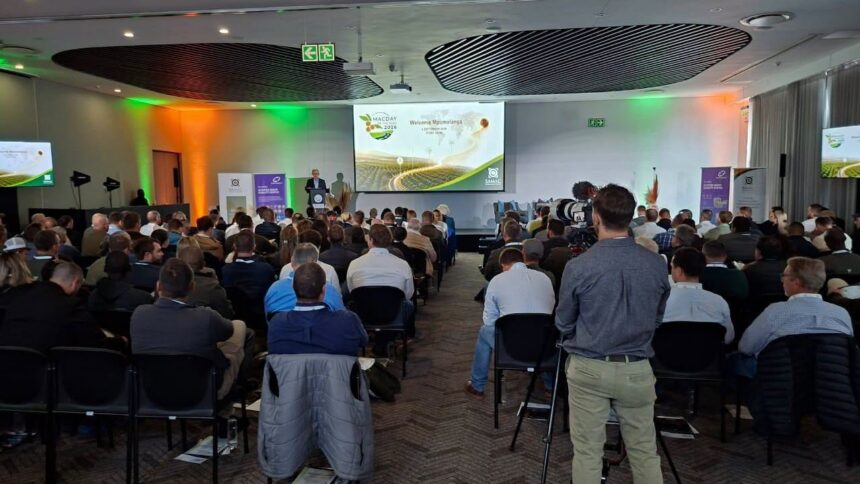
Macadamias South Africa, SAMAC, brought together growers and agricultural stakeholders in Umhlanga for the KwaZulu-Natal leg of MacDay on the Road 2026, placing the future competitiveness of South Africa’s macadamia industry at the centre of discussion. The event, held at the Premier Splendid Inn in Umhlanga, connected international market developments with the practical decisions that growers make on their farms. Macadamia producers were joined by agronomists, researchers and Deputy Minister of Trade, Industry and Competition John Steenhuisen. Discussions focused on market access, export tariffs, logistics, local processing, productivity and transformation within the sector. The engagement highlighted the need for coordinated action between government and industry if South African macadamia production is to remain competitive in international markets.
The macadamia industry operates within a global market where producers compete for consumers, buyers and investment across multiple countries. Changes in international trade policies can have a direct effect on exporters because tariffs influence the cost of products entering foreign markets. Supply-chain disruptions can also affect the movement of agricultural products from farms to international customers. For growers, these issues are not separate from farm-level decisions because market conditions influence production planning, investment and long-term business strategies. MacDay on the Road 2026 provided an opportunity to connect these international developments with the realities facing growers in KwaZulu-Natal.
SAMAC highlighted several priorities that it considers important for the continued development of the South African macadamia sector. These include creating an enabling environment by addressing regulatory and operational constraints that can affect producers. Market access was another major focus, particularly efforts to reduce tariff barriers in high-growth destinations such as India. The industry also emphasized the need to diversify export markets so that South African macadamias are not overly dependent on a limited number of destinations. Value addition and improved logistics were also identified as important areas for strengthening the sector and increasing its contribution to the economy.
The issue of market access received particular attention during Deputy Minister Steenhuisen’s address to regional growers. He described the international trading environment as increasingly complex, with protectionist measures and supply-chain pressures affecting agricultural exporters. His comments emphasized the government’s stated objective of securing conditions that allow South African agricultural products to compete internationally on an equal basis. He specifically pointed to high import duties in markets such as India as an area where trade negotiations could potentially improve opportunities for South African producers. The Department of Trade, Industry and Competition, known as the dtic, intends to use bilateral trade relationships and existing networks as part of efforts to address tariff barriers.
India represents an important point of discussion because access to large and growing consumer markets can create opportunities for agricultural exporters. Tariffs can affect the final price of imported products and therefore influence their competitiveness against products from other exporting countries. Lowering trade barriers does not guarantee increased exports because producers and exporters must also meet requirements relating to quality, food safety, supply reliability and market demand. However, improved tariff conditions can change the commercial environment in which exporters operate. For South African macadamia growers, the ability to access international markets on competitive terms remains closely connected to the long-term development of the industry.
Market diversification was another priority highlighted during the event. Expanding the number of international markets available to South African macadamia producers can help create more options for exporters and reduce reliance on particular destinations. Diversification also requires an understanding of consumer preferences, import regulations, food safety requirements and commercial conditions in each market. The industry therefore needs to combine trade negotiations with consistent production and quality standards. A broader export footprint can support resilience, but its development depends on sustained cooperation between growers, processors, exporters and government.
Logistics formed another major part of the discussion, particularly the performance of South African ports. Efficient export infrastructure is essential for agricultural industries because delays can disrupt supply chains and increase costs. Durban is particularly relevant to KwaZulu-Natal growers because the port forms part of the province’s logistics network and supports the movement of goods into international markets. Steenhuisen highlighted public-private partnerships at the Port of Durban as one approach to addressing cargo delays and improving export throughput. Improving port performance can help exporters move products more efficiently while strengthening the reliability of South Africa’s agricultural supply chains.
The discussion about logistics also shows why competitiveness extends beyond what happens on the farm. A producer can invest in productivity and quality, but difficulties later in the supply chain can still affect the ability to reach international customers efficiently. Export infrastructure, transport systems, port operations and administrative processes all contribute to the final cost and reliability of agricultural exports. Macadamia growers therefore need an agricultural environment in which production and logistics work together. Addressing bottlenecks across the value chain can help ensure that the quality of South African macadamias is supported by an export system capable of serving international markets effectively.
Productivity was identified as one of the core pillars of the strategic roadmap discussed at the event. Modern agricultural technologies can help growers improve their understanding of farm conditions and make more informed production decisions. Precision farming, biological inputs, drone technology and advanced breeding were highlighted as areas that could contribute to higher farm productivity. The practical value of these technologies depends on factors such as cost, farm conditions, technical skills and how effectively growers integrate them into existing production systems. Continued research and knowledge sharing can help producers evaluate technologies and determine where they can provide measurable benefits.
Quality control is equally important for maintaining South Africa’s position in international macadamia markets. Export customers require agricultural products to meet applicable food safety and grading standards. Consistent quality can support confidence among buyers and help protect the reputation of a producing country. Quality management begins with production practices and continues through harvesting, processing, storage and export. Maintaining high standards across these stages requires cooperation among farmers, processors, researchers, industry bodies and regulators.
Local processing was also highlighted as an opportunity to increase the value generated within South Africa. Macadamia nuts can be sold in different forms and can also be used to produce derivative products such as macadamia oil. Increasing domestic processing capacity can create opportunities to develop products beyond the raw agricultural commodity. This can support additional economic activity and potentially create demand for skills, technology, packaging and other services. The development of local value addition must remain commercially viable and connected to market demand, but it represents an important area for industry development.
Inclusion formed another part of the strategic roadmap presented during the engagement. Expanding opportunities for new entrants and small-scale farmers can contribute to broader participation in the macadamia value chain. Meaningful participation requires more than access to production opportunities because farmers may also need technical support, finance, infrastructure, markets and appropriate business development assistance. Sustainable agricultural practices also need to remain part of the sector’s development as producers seek to improve productivity and competitiveness. Combining industry growth with broader participation can help shape the long-term development of the macadamia sector.
The engagement between SAMAC and the dtic also highlighted the importance of public-private collaboration. Government can address areas such as trade negotiations, regulatory conditions and public infrastructure, while industry participants bring practical knowledge of production, processing and markets. Researchers and agricultural specialists can contribute technical expertise and evidence to support better decisions. Growers provide direct experience of the challenges and opportunities encountered on farms. Continued dialogue between these groups can help ensure that policy and industry strategies remain connected to conditions across the macadamia value chain.
MacDay on the Road 2026 therefore provided KwaZulu-Natal macadamia growers with an opportunity to examine both immediate industry challenges and longer-term growth priorities. The discussions covered international market access, tariff barriers, export logistics, productivity, quality control, local processing and inclusion. The participation of Deputy Minister John Steenhuisen also brought the government’s trade and industry perspective into direct engagement with producers. For SAMAC and the wider industry, the event reinforced the importance of maintaining communication between growers, processors, researchers, investors and government. The future competitiveness of South African macadamias will depend on how effectively these stakeholders address market access, production efficiency, infrastructure, value addition and sustainable participation across the sector.
Join 'Farmers Mag' WhatsApp Channel
Get the latest Farming news and tips delivered straight to your WhatsApp
CLICK HERE TO JOIN