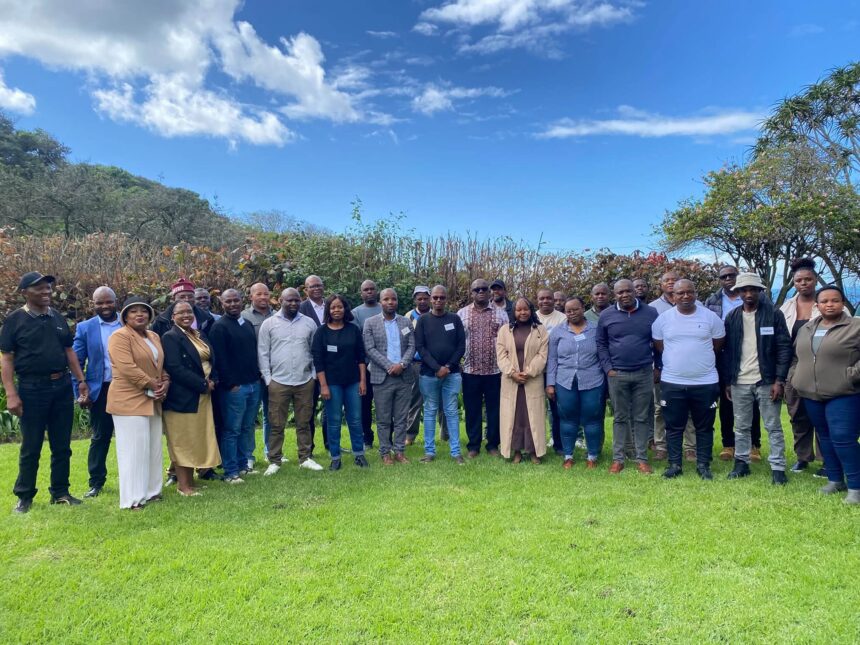
The Eastern Cape Rural Development Agency, ECRDA, together with the International Labour Organization and the Department of Agriculture, has hosted a three-day Energy Management for Irrigation Schemes Training in kuGompo City. The programme brought together key stakeholders to focus on the role of energy management in improving the performance and sustainability of irrigation schemes. Representatives from Eskom and the Council for Scientific and Industrial Research, CSIR, were among those who participated in the training. The initiative aims to help farmers understand how better energy management can support agricultural production while contributing to the transition towards a green economy. The programme also reflects the growing importance of combining agricultural development with efficient and sustainable use of energy resources.
Irrigation plays an important role in agricultural production because it allows farmers to supply crops with water when natural rainfall is insufficient or unreliable. However, irrigation systems depend on energy for activities such as pumping and distributing water, making energy costs an important consideration for many agricultural operations. Poor energy management can increase operating expenses and place additional pressure on the financial sustainability of irrigation schemes. Improving how energy is used can therefore support more efficient agricultural production and help farmers manage operating costs. The training in kuGompo City focuses on building knowledge that can assist participants in identifying opportunities to improve energy use within irrigation schemes.
The involvement of the ECRDA, ILO and Department of Agriculture brings together institutions with different areas of expertise and responsibilities. ECRDA has a role in supporting rural development and agricultural opportunities in the Eastern Cape, while the ILO works on issues connected to employment, skills and inclusive economic development. The Department of Agriculture contributes agricultural knowledge and a sector-specific understanding of the needs of farmers and irrigation schemes. Bringing these perspectives together allows energy management to be considered as part of broader agricultural and rural development. Collaboration among institutions can also help connect technical training with practical challenges faced by farmers.
The participation of Eskom adds an important energy-sector perspective to the programme. Eskom is responsible for electricity generation, transmission and distribution in South Africa, making its knowledge relevant to discussions about electricity use and energy management. Farmers operating irrigation schemes need to understand how their electricity consumption affects operating costs and how energy systems can be managed effectively. Engagement with energy-sector specialists can help participants gain a better understanding of energy use within irrigation operations. It can also create space for discussion around practical energy management challenges faced by agricultural producers.
The involvement of CSIR further strengthens the technical dimension of the training. The organisation conducts research and provides technological expertise across several fields relevant to development and industry. In an agricultural setting, technical knowledge can contribute to understanding energy efficiency, technology options and approaches to improving resource use. Combining research expertise with agricultural experience can help farmers consider how technical solutions could apply to their own irrigation systems. The participation of CSIR therefore adds another layer to the training’s focus on practical energy management and sustainable agricultural development.
Energy management is particularly relevant to irrigation schemes because pumping water can require significant amounts of electricity or other forms of energy. The amount of energy required can depend on factors such as the irrigation system, pumping equipment, water requirements and operating conditions. Farmers and scheme managers who understand these factors can make more informed decisions about how irrigation systems are operated and maintained. Effective energy management can also involve monitoring consumption and identifying areas where unnecessary energy use occurs. The training provides participants with an opportunity to develop knowledge around these issues and consider their relevance to agricultural operations.
The focus on a green economy connects energy management with broader efforts to promote environmentally sustainable economic activity. A green economy aims to support economic development while reducing environmental pressures and improving the efficient use of natural resources. For agriculture, this can involve using energy and water more efficiently, adopting suitable technologies and improving the sustainability of production systems. The transition does not happen through a single intervention because farmers need access to knowledge, appropriate technology, investment and practical support. Training programmes such as the one hosted in kuGompo City can contribute by strengthening the skills needed to understand and manage energy-related challenges.
The three-day format also provides time for participants to engage with the subject in greater depth. Energy management involves more than simply reducing electricity consumption because irrigation systems must continue delivering sufficient water for agricultural production. Farmers need to balance energy use with crop requirements, equipment performance and operational demands. Training can help participants understand how these considerations interact when managing an irrigation scheme. A longer programme can also provide opportunities for questions, discussion and practical consideration of challenges that farmers experience in their own operations.
The initiative is also linked to the Eastern Cape’s broader agricultural potential. ECRDA CEO Mr Simpiwe Somdyala highlighted the province’s significant agricultural potential and the need to fully unlock opportunities within the sector. The Eastern Cape has diverse agricultural activities and rural communities that depend on productive farming systems for economic activity and livelihoods. Unlocking this potential requires attention to production, infrastructure, skills, markets and the efficient use of resources. Energy management forms part of this wider development picture because reliable and efficient energy use can influence the operating environment for irrigation-based agriculture.
Improving agricultural energy management can also support the competitiveness of irrigation schemes. Energy represents an operating cost, and changes in energy efficiency can affect the cost of moving water through an irrigation system. However, the potential benefits depend on the specific characteristics of each scheme, including its equipment, infrastructure and production requirements. Farmers therefore need to assess energy management measures based on their individual circumstances rather than assuming that one approach will work everywhere. Training can provide the foundation for making these assessments and identifying practical areas for improvement.
The programme also demonstrates why partnerships are important when addressing complex agricultural challenges. Farmers operate within systems that involve electricity providers, government departments, research institutions, development agencies and international organisations. Each stakeholder can contribute different knowledge, resources and capabilities to the development process. Cooperation can help ensure that agricultural solutions consider both technical requirements and the economic realities faced by producers. The participation of ECRDA, ILO, the Department of Agriculture, Eskom and CSIR reflects this multi-stakeholder approach to rural agricultural development.
The Energy Management for Irrigation Schemes Training in kuGompo City places skills development at the centre of efforts to strengthen sustainable agriculture in the Eastern Cape. By focusing on energy use within irrigation schemes, the programme addresses a practical issue that affects agricultural operations while connecting it to the wider transition towards a green economy. The participation of government, energy, research and development stakeholders provides participants with access to different areas of expertise. The training also supports the broader objective of unlocking the Eastern Cape’s agricultural potential through improved knowledge and resource management. As farmers and irrigation schemes seek to build more efficient and sustainable production systems, stronger energy management can become an important part of developing productive agricultural opportunities in the province.
Join 'Farmers Mag' WhatsApp Channel
Get the latest Farming news and tips delivered straight to your WhatsApp
CLICK HERE TO JOIN