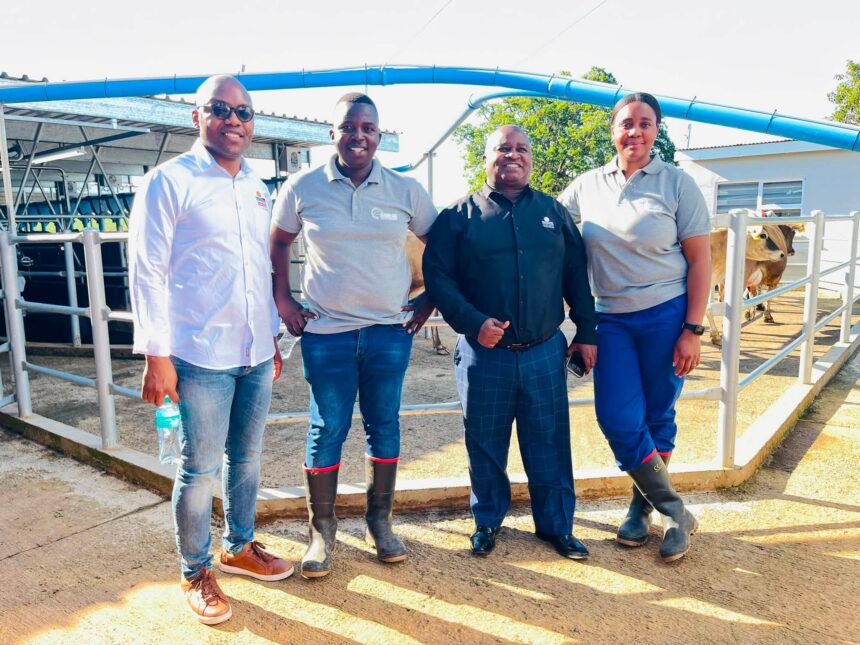
The Land Bank Board and Executive Management visited Mr Tshilidzi Matshidzula, a Blended Finance beneficiary at Redlands Farm in the Stutterheim district of the Eastern Cape, gaining valuable first-hand insight into the realities facing farmers on the ground. The visit provided an opportunity for Land Bank leadership to engage directly with a farmer whose business has been affected by Foot-and-Mouth Disease (FMD). Such engagements are important because agricultural challenges can have different effects depending on the size, location and nature of a farming operation. For farmers, disease outbreaks can affect livestock health, production, cash flow and access to markets. The visit therefore highlighted the importance of financial institutions understanding the practical challenges faced by their clients while supporting efforts to build a stronger agricultural sector.
Mr Matshidzula’s experience at Redlands Farm illustrates how livestock disease can create significant pressures for agricultural businesses. Foot-and-Mouth Disease is highly contagious among susceptible cloven-hoofed animals and can disrupt normal farming activities when outbreaks occur. Farmers may face restrictions on animal movement, difficulties accessing markets and increased costs associated with disease control and livestock management. These pressures can affect a farm’s ability to generate income and meet its financial commitments, particularly when disruptions continue over an extended period. Direct engagement with affected farmers gives agricultural stakeholders a clearer understanding of these challenges and the practical measures required to help businesses remain resilient.
The visit also highlighted the role of Blended Finance in supporting agricultural development and helping farmers access the resources required to establish or strengthen their operations. Blended Finance combines different sources of funding or financial support to improve access to finance for agricultural businesses that may face challenges obtaining conventional commercial funding. For beneficiaries such as Mr Matshidzula, this type of support can contribute to the development and sustainability of farming operations while helping unlock opportunities within the agricultural value chain. However, access to finance does not remove the operational risks associated with farming, including livestock diseases, market disruptions and changing production conditions. Continued engagement between financial institutions and farmers is therefore important to ensure that financing support responds to real conditions on the ground.
Foot-and-Mouth Disease remains a serious concern for livestock producers because of its potential to affect both individual farms and the wider agricultural economy. When an outbreak occurs, authorities may introduce movement controls and other measures to reduce transmission between herds. These interventions can have consequences for farmers who rely on regular livestock sales or need to move animals as part of normal production cycles. Market disruptions can also affect income across related industries, including livestock transport, auctions, processing and agricultural services. Understanding these interconnected impacts is essential when considering how farmers can be supported during periods of disease-related disruption.
The Land Bank leadership’s decision to engage directly with Mr Matshidzula reflects the value of listening to farmers when developing and implementing agricultural finance strategies. Farming conditions can change quickly, and a financial institution cannot fully understand the challenges faced by its clients through financial statements and routine administrative processes alone. Visiting farms allows decision-makers to see production conditions, discuss challenges directly with producers and gain a better understanding of the factors affecting business performance. These conversations can also help identify areas where farmers may need additional support or where existing financial arrangements may need to be considered within the context of unexpected agricultural risks. Stronger communication between farmers and financial institutions can contribute to more informed and practical approaches to agricultural financing.
For farmers affected by FMD, resilience depends on more than access to capital. Producers also need effective disease management, reliable veterinary support, appropriate infrastructure and access to markets when restrictions are lifted. Financial planning becomes particularly important during periods when income may be reduced or delayed because of livestock movement restrictions or changes in market conditions. Farmers must often balance the costs of maintaining their operations with the uncertainty created by disease outbreaks. Engagement between farmers and financial institutions can help ensure that these realities remain part of broader discussions about agricultural sustainability.
The visit to Redlands Farm also demonstrates the importance of understanding agriculture at a local level. Conditions in the Eastern Cape can differ significantly between farming areas, with producers facing different environmental, market and operational challenges. A farmer’s experience with FMD may also depend on the type of livestock operation, herd size and access to veterinary and agricultural services. By engaging with individual beneficiaries, Land Bank can gain insights that may not be apparent from broader industry data. These insights can help strengthen the institution’s understanding of how agricultural finance can support farmers through both normal operating conditions and periods of significant disruption.
Sustainable agriculture requires farmers to manage both opportunities and risks over the long term. Financial support can provide a foundation for investment in livestock, infrastructure, equipment and other productive assets, but farmers must also be able to respond to unexpected challenges. Disease outbreaks such as FMD can test the resilience of even established farming businesses by affecting production and market access at the same time. This makes responsible financial planning and ongoing engagement particularly important for agricultural enterprises. Supporting farmers through difficult periods can help protect productive businesses and preserve the economic activity they generate within rural communities.
The visit further reinforces the importance of collaboration within the agricultural sector. Farmers, financial institutions, government departments, veterinary authorities and other agricultural stakeholders all have roles to play in strengthening the resilience of livestock production. No single organisation can address the full range of challenges created by disease outbreaks and market disruptions. Effective collaboration can improve access to information, financial support, veterinary services and other resources needed by farmers. Direct engagement provides an opportunity to strengthen these relationships and ensure that responses to agricultural challenges remain grounded in the experiences of producers.
For Mr Matshidzula, the visit provided an opportunity to share the realities of running a farming business during a period affected by FMD. For Land Bank, it offered valuable insight into the circumstances of a Blended Finance beneficiary and the pressures affecting agricultural enterprises in the Eastern Cape. Such engagement can help strengthen the relationship between the institution and the farmers it serves. It also reinforces the principle that agricultural finance should be informed by the realities of farming rather than relying solely on financial and administrative indicators. Understanding those realities is essential for building financing approaches that support productive and sustainable agricultural businesses.
The visit to Redlands Farm ultimately highlights the importance of farmer engagement in building a sustainable and resilient agricultural sector. Mr Tshilidzi Matshidzula’s experience demonstrates how Foot-and-Mouth Disease can affect farming businesses beyond the immediate health of livestock, creating wider challenges involving production, income, movement and market access. By meeting directly with beneficiaries, Land Bank’s Board and Executive Management can better understand these pressures and strengthen its approach to supporting agricultural clients. Continued collaboration between farmers and financial institutions will be important as the sector responds to disease risks and other challenges that affect rural economies. Direct engagement such as this can help ensure that agricultural finance remains connected to the realities of farming and contributes to stronger, more resilient businesses across South Africa.
Join 'Farmers Mag' WhatsApp Channel
Get the latest Farming news and tips delivered straight to your WhatsApp
CLICK HERE TO JOIN