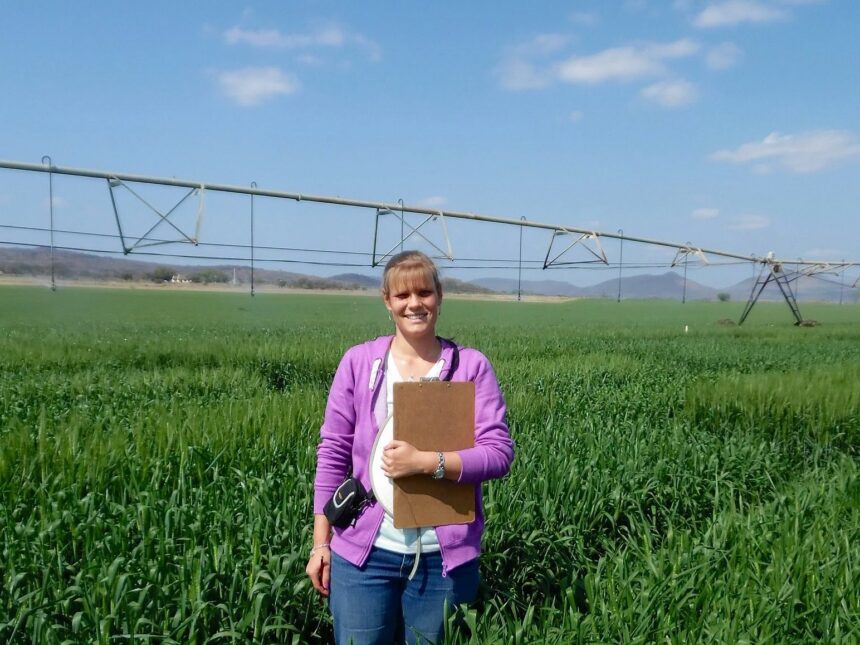
For South African wheat farmers, choosing the right cultivar can make an important difference to the performance and profitability of a crop. Behind many of the wheat varieties available to producers are plant breeders who spend years selecting and testing plants for traits that can help farmers deal with real production challenges. One of these researchers is Kim Delport, the Agricultural Research Council’s Small Grain lead wheat breeder for spring wheat cultivars in irrigation areas. Since joining the ARC in 2013, Kim has focused on developing improved wheat cultivars that can deliver competitive yields while also offering traits such as disease resistance, adaptability and good bread-making quality. Her work is becoming increasingly important as farmers face rising temperatures, changing weather conditions and the need to produce more food locally.
Kim brought a strong scientific foundation to the ARC, including an MSc in Plant Breeding from Stellenbosch University. Her work over the past 13 years has involved evaluating large numbers of wheat lines and selecting those with characteristics that could benefit South African producers. Plant breeding is a long-term process, and a promising wheat line must go through extensive testing before it can become a cultivar that farmers can plant commercially. Breeders need to assess how plants perform under different conditions and whether they can consistently deliver the characteristics required by both farmers and the market. This means Kim’s work involves much more than simply searching for wheat plants with high yields.
Yield is obviously one of the first things farmers consider when selecting a cultivar, but it is not the only factor that matters. A cultivar that produces a high yield but is highly susceptible to disease or performs poorly when temperatures rise may create other problems for the farmer. Kim and her team therefore consider several traits when evaluating wheat lines, including disease resistance, performance under different growing conditions and bread-making quality. These characteristics can influence both the performance of a crop in the field and the value of the grain after harvest. The aim is to develop cultivars that give farmers a strong overall package rather than focusing on a single characteristic.
The scale of this work is considerable because thousands of wheat lines are evaluated each year. Each line can contain different combinations of genetic characteristics, and breeders must identify those that have the greatest potential for South African conditions. Through repeated testing and selection, weaker lines are removed while promising material moves forward for further evaluation. This process requires detailed observations, accurate data and patience because breeding decisions made at one stage can affect the development of cultivars years later. For farmers, this extensive testing is important because a cultivar needs to perform reliably before it can become a useful commercial option.
South Africa’s dependence on imported wheat makes this breeding work particularly relevant. Wheat is the country’s second most important grain crop, yet around half of the wheat consumed annually is imported. Local production therefore needs to remain competitive and productive if the country is to strengthen its food security and reduce some of the risks associated with relying heavily on international supplies. Farmers need cultivars that can perform under South African conditions and provide returns that justify the cost of production. Research that improves the genetic potential of local wheat production can contribute to this goal by giving producers better planting options.
Kim has already made a significant contribution to this effort. During her time at the ARC, she has developed five improved wheat cultivars, with two receiving final approval in June 2026. These two cultivars are expected to become available to farmers in the near future, giving producers additional options for their wheat production systems. The approval represents years of breeding, testing and selection and shows how long-term agricultural research eventually translates into products that can reach the farm. Once new cultivars enter commercial production, farmers can assess how they perform under their own conditions and determine where they fit into their farming programmes.
The arrival of new cultivars is particularly important because farmers do not operate under identical conditions. Soil types, temperatures, water availability, disease pressure and production systems can differ from one farming area to another. A cultivar that performs well in one environment may not necessarily deliver the same results somewhere else, which is why breeders test plants under a range of conditions. Spring wheat cultivars developed for irrigation areas need to perform within the specific production environments where farmers have access to irrigation but may still face heat and other stresses. Providing farmers with a wider selection of well-tested cultivars allows them to choose varieties that best match their production objectives and local conditions.
Disease resistance is another major consideration in the breeding programme. Crop diseases can reduce yields and affect grain quality, while managing disease can add costs to a farming operation. Cultivars with useful levels of resistance can help farmers manage these risks as part of an integrated crop production strategy. Resistance does not remove the need for farmers to monitor crops and follow appropriate disease management practices, but it can provide an important additional tool. For producers, having access to cultivars with stronger disease resistance can contribute to more reliable crop performance and potentially reduce some of the pressure associated with disease outbreaks.
Grain quality also matters because wheat produced on the farm eventually enters a value chain that includes millers, bakers and consumers. A crop must therefore meet requirements beyond what happens in the field. Kim and her team consider bread-making quality when developing cultivars because the end use of the wheat is an important part of determining its value. Good agricultural performance combined with suitable quality characteristics can make a cultivar more useful across the broader wheat industry. This approach ensures that breeding decisions take into account both the farmer’s production needs and the requirements of the market.
Climate change is making the development of resilient wheat cultivars increasingly important. Rising temperatures can affect wheat growth and development, while drought and heat stress can reduce crop performance when conditions become severe. Farmers cannot control the weather, but they can make production decisions that help them manage environmental risks. Choosing cultivars with traits that improve tolerance to heat and limited water availability can be one part of that strategy. Kim is therefore working on breeding material that can help wheat remain productive as growing conditions become more challenging.
Her work includes the use of wheat lines containing genetic traits associated with heat tolerance. Some of this material is sourced through international wheat improvement programmes, giving the breeding programme access to genetic resources from beyond South Africa. These lines can then be evaluated to determine whether their traits can contribute to cultivars that perform well under local conditions. International cooperation is valuable because breeders need access to diverse genetic material when searching for characteristics that may help address emerging challenges. Combining these resources with local research and testing can help produce wheat cultivars that are better adapted to the conditions South African farmers face.
Heat tolerance is becoming particularly important for farmers because high temperatures can occur at critical stages of crop development. Even where irrigation is available, higher temperatures can place additional stress on plants and affect yield potential. This means irrigation does not completely remove the need for cultivars that can cope with heat. Breeding for improved heat tolerance gives farmers another tool for managing changing environmental conditions while maintaining production. The work being done today can therefore help prepare wheat farmers for conditions that may become more common in the years ahead.
Drought tolerance also has an important place in the future of wheat breeding. Water is a critical resource for crop production, and farmers need to use available water efficiently while protecting yields. Genetic traits that help plants cope with water stress can contribute to more resilient production systems. Breeding cannot replace good irrigation management, soil management or sound agronomic practices, but it can complement them. The combination of appropriate cultivars and good farm management will become increasingly important as farmers deal with greater climate variability.
For farmers, the value of Kim’s work ultimately comes down to the choices it can provide in the field. New cultivars give producers opportunities to compare different varieties and select those that match their production systems, market requirements and risk-management strategies. Farmers can consider characteristics such as yield potential, disease resistance, quality and tolerance to environmental stresses when deciding what to plant. The availability of improved cultivars also gives producers access to genetic progress generated through years of agricultural research. This connection between research and practical farming is what makes plant breeding such an important part of the agricultural sector.
The development of new cultivars also shows why agricultural research needs sustained support. A wheat breeder cannot develop a commercially useful cultivar within a single season because the process requires multiple stages of selection and evaluation. Researchers need access to field trials, genetic material, technical expertise and reliable information to make effective breeding decisions. Long-term research programmes allow scientists to build on previous work while responding to new challenges such as climate change and emerging diseases. Continued investment in plant breeding can therefore help ensure that farmers have access to improved genetic material in the future.
Kim’s work also demonstrates the important role of people behind South Africa’s agricultural research system. Farmers see the results of breeding programmes in the cultivars they plant, but much of the research and testing that produces those cultivars takes place long before a seed reaches the farm. Scientists such as Kim spend years evaluating plants, studying their characteristics and making careful breeding decisions. Their work requires a combination of scientific knowledge, practical understanding and a clear focus on what producers and the market need. By developing wheat suited to South African production conditions, these researchers help strengthen the link between agricultural science and farming practice.
The two wheat cultivars approved in June 2026 mark an important milestone in Kim’s career and provide a tangible example of the progress being made through the ARC’s breeding work. As the cultivars become available to farmers, their performance in commercial production will provide further information about their potential and suitability. Farmers will ultimately make their own decisions based on factors such as local conditions, production costs, market requirements and the characteristics of each cultivar. The important point is that producers will have new genetic options to consider as they plan future wheat crops. These developments are particularly valuable at a time when farmers are being asked to produce efficiently while managing greater environmental and economic pressures.
Kim Delport’s contribution to wheat breeding shows how agricultural research can provide practical tools for farmers while supporting a much bigger national objective. Her work has produced five improved wheat cultivars so far, with two receiving final approval in June 2026, and her focus on heat and drought tolerance is helping prepare wheat production for changing conditions. By also considering yield, disease resistance and bread-making quality, she is working towards cultivars that can meet the needs of farmers and the wider wheat value chain. Her research is especially significant for South Africa, where around half of the wheat consumed each year is imported and stronger domestic production remains important for food security. As part of the People of the ARC, Kim represents the scientists whose knowledge, persistence and research help farmers access better planting material and help build a stronger, more resilient and more food-secure South African agricultural sector.
Join 'Farmers Mag' WhatsApp Channel
Get the latest Farming news and tips delivered straight to your WhatsApp
CLICK HERE TO JOIN