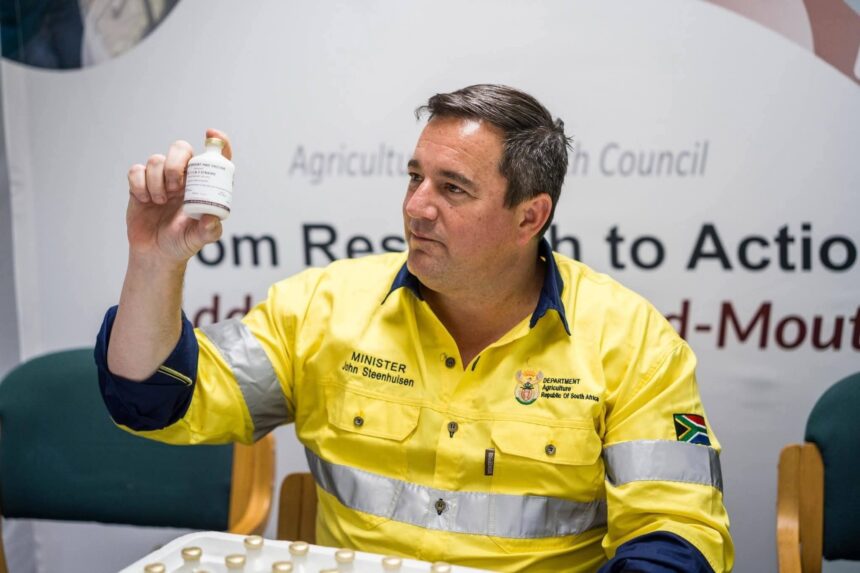
The Agricultural Research Council has confirmed the release of 20 000 doses of locally produced Foot and Mouth Disease vaccine, marking a key step in strengthening South Africa’s response to one of the most serious livestock diseases. This development signals progress in rebuilding the country’s vaccine production capacity and reducing dependence on imports. The release forms part of a broader national effort to improve disease control, protect livestock, and support food security. Minister of Agriculture John Steenhuisen welcomed the milestone and emphasised its importance in achieving long term sustainability in animal health management. The announcement also reflects growing momentum in efforts to expand vaccination coverage across the country.
The latest batch follows the initial release of 12 900 doses on 6 February 2026, when the Agricultural Research Council committed to scaling up production to reach 20 000 doses by the end of March. Meeting this target demonstrates improved operational capacity and effective planning within the organisation. Minister Steenhuisen noted that further investments are already being directed toward expanding production infrastructure over the medium term. These investments aim to ensure a consistent and reliable supply of vaccines that aligns with the national disease management strategy. He stressed that vaccine availability remains central to reaching the government’s goal of vaccinating 80 percent of susceptible livestock by the end of the year.
Efforts to scale up local production will continue, with the Agricultural Research Council planning to produce additional batches of around 20 000 doses on a weekly basis. These batches will include vaccines targeting SAT 1, SAT 2, and SAT 3 strains, depending on prevailing disease patterns. Production plans remain flexible to respond to changes in circulating strains, allowing for adjustments in both vaccine composition and manufacturing timelines. This adaptive approach ensures that vaccination programmes remain effective and relevant to current disease risks. By maintaining a steady output of vaccines, the council aims to provide farmers and veterinary services with timely access to essential disease prevention tools.
The expansion of local manufacturing has already contributed to a significant increase in the number of vaccinated animals. Since early February 2026, more than 1.7 million animals have been vaccinated through a combination of locally produced doses and imported vaccines. Strategic international partnerships have supported this effort, with one million doses sourced from Biogénesis Bagó in Argentina and 1.5 million doses from Dollvet in Turkey. Additional shipments are expected during April, including 3.5 million more doses that will further accelerate vaccination campaigns. This coordinated approach between local production and international supply highlights the importance of collaboration in managing large scale animal health challenges.
Dr Litha Magingxa, President and Chief Executive Officer of the Agricultural Research Council, stated that expanding manufacturing capacity is critical for protecting livestock and ensuring food security. He emphasised that improved access to vaccines enables farmers to safeguard their herds against outbreaks that can cause severe economic losses. Reliable vaccination programmes also support the stability of the agricultural sector, which plays a key role in the national economy. By strengthening production systems and distribution networks, the council is helping to build resilience against future disease threats. These efforts contribute to a more secure and sustainable livestock industry.
The release of locally produced FMD vaccine doses represents a turning point in South Africa’s approach to disease control and agricultural sustainability. It shows clear progress in restoring national production capabilities while maintaining strong partnerships with international suppliers. Continued investment and consistent output will be essential in meeting vaccination targets and protecting the country’s livestock population. The combined strategy of local manufacturing and global collaboration positions South Africa to respond more effectively to animal health risks. As vaccination efforts expand, the country moves closer to securing its agricultural future and strengthening food security for years to come.
Join 'Farmers Mag' WhatsApp Channel
Get the latest Farming news and tips delivered straight to your WhatsApp
CLICK HERE TO JOIN