

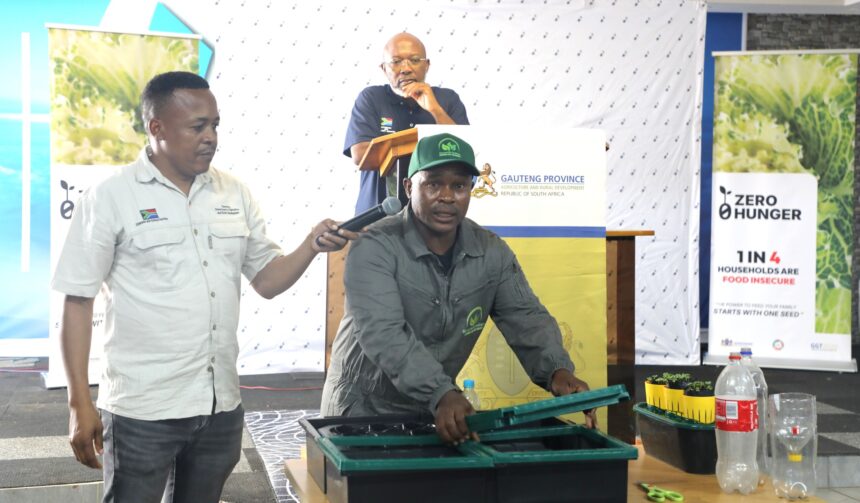
On 20 March, the Etwatwa community in Gauteng witnessed a major step toward urban food security as MEC Vuyiswa Ramokgopa, alongside the GDARD team, facilitated the handover of Hydro Grow Smart Boxes and essential food parcels. This initiative combines immediate food support with practical tools for sustainable crop production, allowing residents to grow fresh vegetables at home. Ward Councillor Mr. Mzwakhe Khumalo welcomed the event, while GDARD Chief Director Mr. Mncedisi Madolo highlighted the province’s goal of fostering self-sufficient, resilient communities. By integrating innovative urban farming solutions with community engagement, the programme moves beyond temporary relief, equipping households with knowledge and tools to manage their own nutrition. The initiative demonstrates a scalable model that other urban and peri-urban areas in South Africa could adopt to improve food security.
A key focus of the event was a practical demonstration by Siyoyisilel Indlala Community Farm and Projects, showcasing how Hydro Grow Smart Boxes function in small spaces. The modular systems are designed for easy setup, minimal water usage, and efficient space management, making them ideal for urban households or informal settlements. Participants were shown how to plant a variety of vegetables, including spinach, tomatoes, and peppers, using these boxes in both soil-based and hydroponic setups. The demonstration emphasized crop rotation, companion planting, and basic pest control to ensure healthy yields and continuous harvests. Residents were also taught watering schedules, nutrient management, and the importance of sunlight, providing them with hands-on skills to maintain productive mini-gardens at home.
MEC Ramokgopa stressed that the initiative represents a long-term shift toward self-reliance and sustainable urban agriculture. By giving residents the tools and knowledge to grow their own food, the programme reduces dependence on external food sources while building household resilience. Beyond immediate nutrition, the starter packs encourage families to adopt systematic growing practices, track crop growth, and experiment with seasonal planting. These skills can be scaled as residents expand their gardens or share knowledge with neighbours, creating a network of small urban farms. The focus on sustainability and productivity ensures that this intervention benefits both food security and community capacity building.
The event also highlighted the importance of integrating modern agricultural techniques into community projects. Participants were trained on soil preparation, seed selection, organic fertilizers, and water conservation methods. They were encouraged to document growth cycles, monitor pest activity, and manage harvests efficiently. By combining these practical techniques with accessible tools like the Smart Boxes, households can optimize yields even in limited space. The programme also introduced ideas for small-scale income generation, showing how surplus produce can be sold in local markets, further linking urban farming with economic empowerment.
The Zero Hunger initiative in Etwatwa demonstrates a replicable model for other urban and peri-urban communities across Gauteng and South Africa. By pairing innovative growing systems with technical training, government support, and community involvement, the programme creates lasting impact. MEC Ramokgopa’s leadership underscores the importance of policy-driven interventions that prioritize both food security and practical farming solutions. Residents left the event with not only food parcels but also the knowledge, confidence, and tools to grow nutritious crops sustainably. With continued support, this approach positions urban farming as a viable strategy for reducing hunger, empowering communities, and promoting agricultural innovation in densely populated areas.
Join 'Farmers Mag' WhatsApp Channel
Get the latest Farming news and tips delivered straight to your WhatsApp
CLICK HERE TO JOIN




