

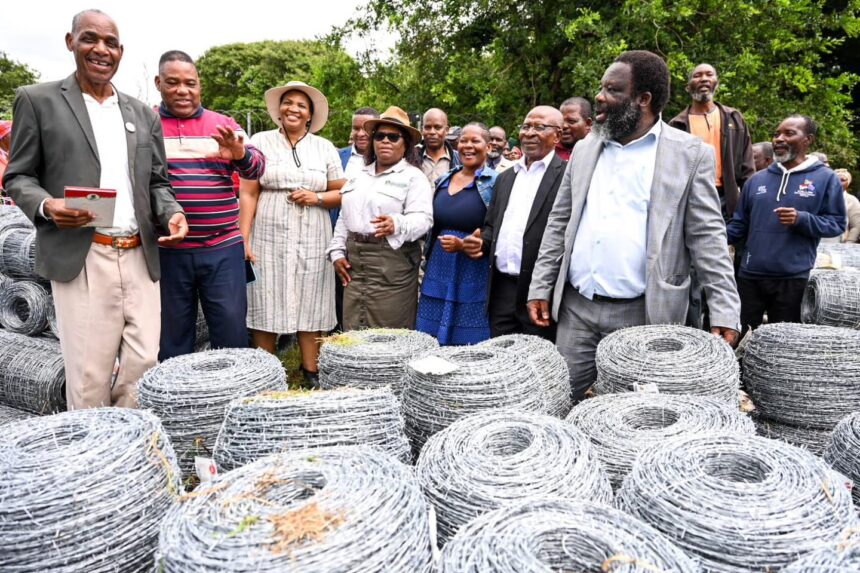
The KwaZulu-Natal Department of Agriculture and Rural Development continues to strengthen support for rural farmers through practical interventions that address everyday farming challenges. Following the official handover of irrigation scheme projects and fencing to farmers in the uMkhanyakude District on 11 March 2026, the programme has now extended to the Zululand District. Led by MEC for Agriculture and Rural Development, Hon. Thembeni KaMadlopha-Mthethwa, this initiative focuses on improving farm security and boosting productivity. The rollout of fencing materials reflects a clear commitment to supporting small scale and emerging farmers who often face losses due to uncontrolled livestock movement. This effort forms part of a wider strategy to build a more resilient and self sufficient agricultural sector in KwaZulu-Natal.
Access to proper fencing is a critical need for many farmers in rural areas, where open grazing and shared land boundaries often lead to crop damage. Without adequate protection, farmers can lose significant portions of their harvest to stray animals, which directly affects income and food availability. The provision of fencing materials addresses this issue by creating secure farming spaces that reduce the risk of external damage. Farmers can now better manage their land and protect their investments, which leads to more stable production cycles. This type of support allows farmers to focus on improving yields instead of constantly dealing with preventable losses.
The initiative also supports household food security by enabling families to produce food more consistently throughout the year. When crops are protected from damage, farmers can plan their planting and harvesting schedules with greater confidence. This stability improves access to fresh produce at household level and reduces reliance on external food sources. In many rural communities, agriculture is a primary source of both food and income, making such interventions highly impactful. By securing farmlands, the department is helping to create a reliable foundation for sustainable livelihoods. This approach directly contributes to reducing food insecurity in vulnerable areas.
In addition to improving food production, the fencing rollout encourages long term agricultural development and self sufficiency. Farmers who can protect their crops are more likely to invest in expanding their operations and adopting better farming techniques. This creates opportunities for growth, including participation in local markets and value chains. The continued involvement of the department ensures that farmers receive not only materials but also guidance on how to maximise the benefits of these resources. Over time, such support can transform small farming operations into stable and productive enterprises. This contributes to broader economic development within the province.
The rollout of fencing materials to farmers in the Zululand District marks another important step in KwaZulu-Natal’s commitment to agricultural development. Building on earlier efforts in uMkhanyakude, this initiative addresses a practical challenge that has long affected rural farmers. By protecting crops from livestock intrusion and external damage, the programme enables consistent food production and strengthens household resilience. Farmers gain the security needed to grow, plan, and sustain their operations with confidence. This ongoing support highlights the province’s focus on creating a more inclusive, productive, and sustainable agricultural sector for all.
Join 'Farmers Mag' WhatsApp Channel
Get the latest Farming news and tips delivered straight to your WhatsApp
CLICK HERE TO JOIN




