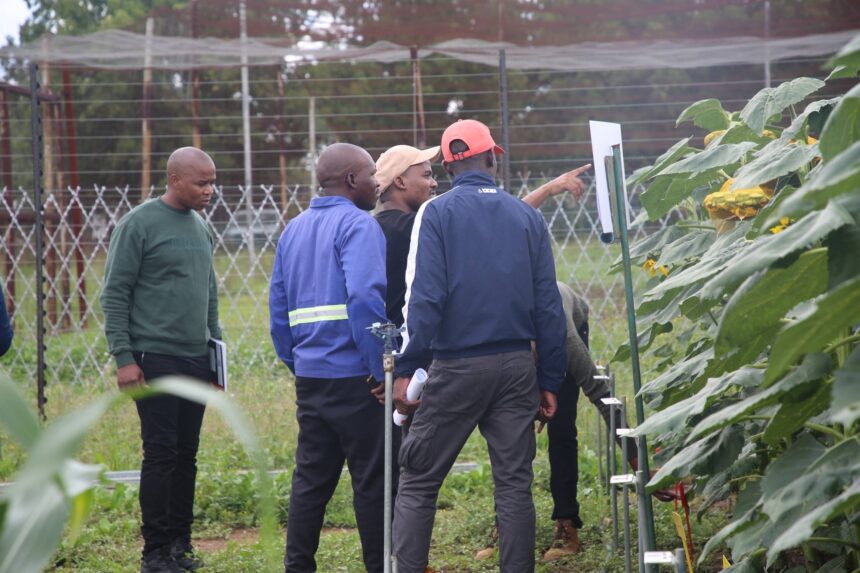
Practical learning is becoming increasingly important in South African agriculture, bridging the gap between research, innovation, and the farm. On 24 March 2026, third-level Field Crops students from the University of South Africa (UNISA) visited the ARC-Grain Crops facility in Potchefstroom for a hands-on immersion into crop production. The visit focused on maize, sorghum, and sunflower systems, allowing students to observe field trials, grain handling, and storage processes firsthand. Engaging directly with researchers provided the students with an opportunity to see science applied in real agricultural settings. Such experiences demonstrate how classroom knowledge translates into practical farming solutions, preparing the next generation of agronomists for the challenges of modern agriculture.
During the visit, students explored field plots where maize, sorghum, and sunflower were in various growth stages. They were introduced to crop management techniques such as irrigation scheduling, pest and disease monitoring, and soil fertility practices. In the storerooms, students learned about post-harvest handling, moisture management, and storage strategies to preserve grain quality and reduce losses. Seeing these processes in action reinforced the importance of precision and planning in successful crop production. The visit emphasized that understanding both field conditions and post-harvest practices is crucial for maximizing yields and profitability.
The interaction with researchers also highlighted the role of innovation in agriculture. Students learned how research informs decisions about variety selection, climate adaptation, and pest-resistant crops. Discussions included the latest findings on sustainable practices that reduce input costs while maintaining high productivity. Observing these applications firsthand showed how data-driven approaches can improve decision-making on farms. For farmers reading the magazine, these insights underscore the value of integrating research knowledge into daily agricultural operations.
Hands-on exposure also strengthens critical thinking and problem-solving skills. Students were encouraged to analyze crop performance, identify challenges, and propose solutions based on their observations. This approach fosters practical decision-making and prepares students for real-world farm management scenarios. It also provides inspiration for young agronomists to innovate and experiment with new techniques on their own farms. Seeing research applied in the field demonstrates how small improvements in crop management can yield significant results in productivity and profitability.
The ARC-Grain Crops visit provides an excellent model of how practical engagement enhances agricultural education. Students gained valuable insights into maize, sorghum, and sunflower production while seeing the direct impact of research on farm operations. For farmers, the visit highlights the importance of adopting evidence-based practices and remaining open to innovation. By combining classroom knowledge with field experience, South Africa’s future agronomists are better equipped to improve productivity, sustainability, and resilience in crop production. Practical learning initiatives like this ensure that research not only advances science but also strengthens the agricultural sector on the ground.
Join 'Farmers Mag' WhatsApp Channel
Get the latest Farming news and tips delivered straight to your WhatsApp
CLICK HERE TO JOIN