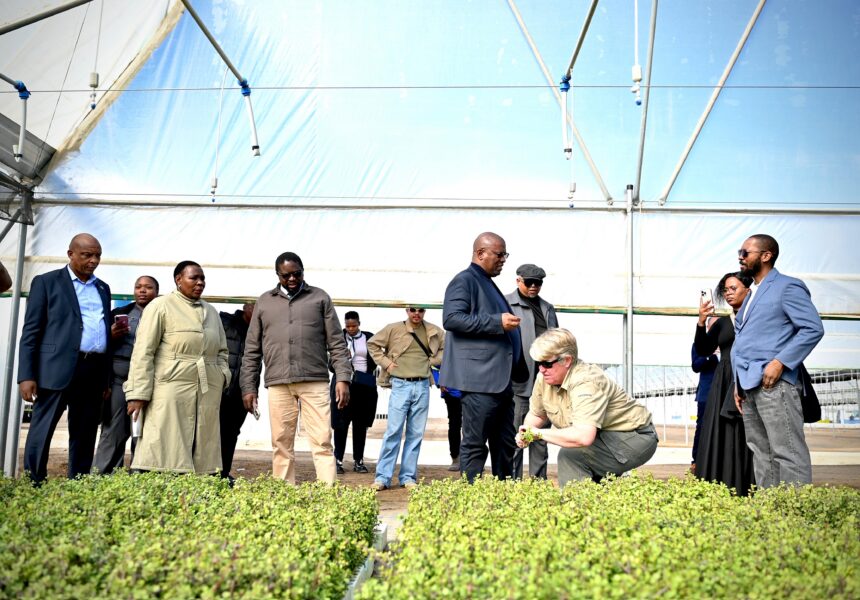
Eastern Cape Premier Lubabalo Oscar Mabuyane has welcomed a major R1.6 billion investment to expand the Spekboom restoration project in Jansenville, calling it a clear sign that environmental restoration can directly support jobs and improve livelihoods. The announcement marks a significant milestone for the province’s growing green economy strategy, which links ecological recovery with economic development. Mabuyane emphasized that the project is not only about planting Spekboom or repairing degraded land, but also about creating real opportunities for people living in rural communities. He said the initiative proves that environmental protection and economic progress can happen together when investment is directed into long-term sustainable projects. The expansion positions the Eastern Cape as a key player in nature-based solutions that address both unemployment and climate change.
The latest phase of the project will inject approximately US$91 million, equivalent to around R1.6 billion, into the Eastern Cape economy. This investment forms part of a broader international partnership involving Amazon, the World Bank and other global investors committed to carbon sequestration and land restoration. Combined with the first phase launched in 2024, total investment in the Spekboom restoration initiative now exceeds US$114 million, or more than R2 billion. The project spans approximately 60,000 hectares of land across the province, making it one of the largest ecological restoration efforts in the region. This scale of investment highlights growing global confidence in South Africa’s ability to deliver impactful environmental and economic projects.
For communities in the Eastern Cape, the benefits of the project are expected to be direct and measurable. The initiative is projected to create around 11,000 jobs by 2031, offering employment in nursery operations, planting teams, transport services and contractor support roles. Many of these opportunities will be accessible to young people, women and small business owners in rural areas where employment opportunities remain limited. The project also prioritizes local economic inclusion, with more than two-thirds of contracted small businesses being Black-owned and over 40 percent owned by women. These figures reflect a deliberate effort to ensure that economic transformation is embedded within environmental development.
Premier Mabuyane stressed that the project represents more than environmental restoration, describing it as a tool for dignity and economic participation. He explained that rural communities often face limited access to formal employment, making initiatives like this critical for inclusive growth. By linking land restoration to job creation, the province aims to address structural inequality while building a sustainable economic model. The project also strengthens local supply chains by involving small businesses in logistics, planting and maintenance activities. This approach ensures that economic benefits circulate within communities rather than being concentrated in external markets.
Beyond its economic impact, the Spekboom restoration project plays an important environmental role in reversing land degradation. Spekboom, a resilient indigenous plant native to the Eastern Cape, is known for its ability to improve soil health and restore degraded ecosystems. It also absorbs significant amounts of carbon dioxide, making it an effective natural tool in the fight against climate change. The plant supports biodiversity by creating habitats for insects, birds and other wildlife, contributing to healthier ecosystems across restored areas. These environmental benefits reinforce the project’s long-term value beyond immediate economic gains.
Mabuyane highlighted that the initiative demonstrates how the province can lead in the global transition toward a green economy. He stated that the Eastern Cape cannot afford to remain on the sidelines while new industries emerge elsewhere. Instead, the province aims to ensure that its communities actively participate in and benefit from green economic opportunities. The Spekboom project serves as a model for how environmental investment can be structured to deliver both ecological restoration and socio-economic upliftment. It also positions the province as a destination for future climate-related investment.
To support the expansion of this sector, the provincial government has tasked the Eastern Cape Socio Economic Consultative Council with establishing a Carbon Sequestration Unit. This unit will focus on attracting investment, building technical skills and supporting projects that generate employment through environmental restoration. It is also expected to coordinate efforts between municipalities, educational institutions, communities and private sector partners. By creating a centralized structure, the province aims to improve efficiency and scale up participation in the green economy. The unit will play a key role in ensuring that carbon credit projects are properly managed and financially sustainable.
The collaboration between public institutions and international investors has been highlighted as a key strength of the project. Scobie Mackay, Chief Executive Officer of Imperative, noted that the initiative brings together private investors, development finance institutions and long-term carbon credit buyers in a structured and scalable way. He explained that this model could be replicated in other regions seeking to link environmental restoration with economic development. According to Mackay, the project contributes to global efforts to establish nature as a viable and investable asset class. This approach reflects a growing shift in how environmental assets are valued in global financial systems.
The long-term vision of the Spekboom restoration project is centered on creating sustainable impact for both people and the environment. By restoring degraded land at scale, the initiative strengthens climate resilience while generating consistent employment opportunities. It also builds local capacity through skills development and enterprise participation, ensuring that communities benefit beyond the lifespan of individual project phases. The integration of environmental science, investment capital and local participation creates a balanced development model. This model demonstrates how climate action can be aligned with economic transformation goals.
Premier Mabuyane reiterated that the ultimate goal of the project is to ensure that ordinary people experience tangible benefits from the green economy. He emphasized that sustainable development must translate into jobs, income and improved living conditions for communities across the province. The Spekboom restoration initiative stands as a powerful example of how environmental restoration can be transformed into economic opportunity at scale. As the project expands, it is expected to strengthen the Eastern Cape’s position as a leader in climate-smart development. The combination of investment, innovation and inclusion sets a strong foundation for a more resilient and prosperous future for the province.
Join 'Farmers Mag' WhatsApp Channel
Get the latest Farming news and tips delivered straight to your WhatsApp
CLICK HERE TO JOIN