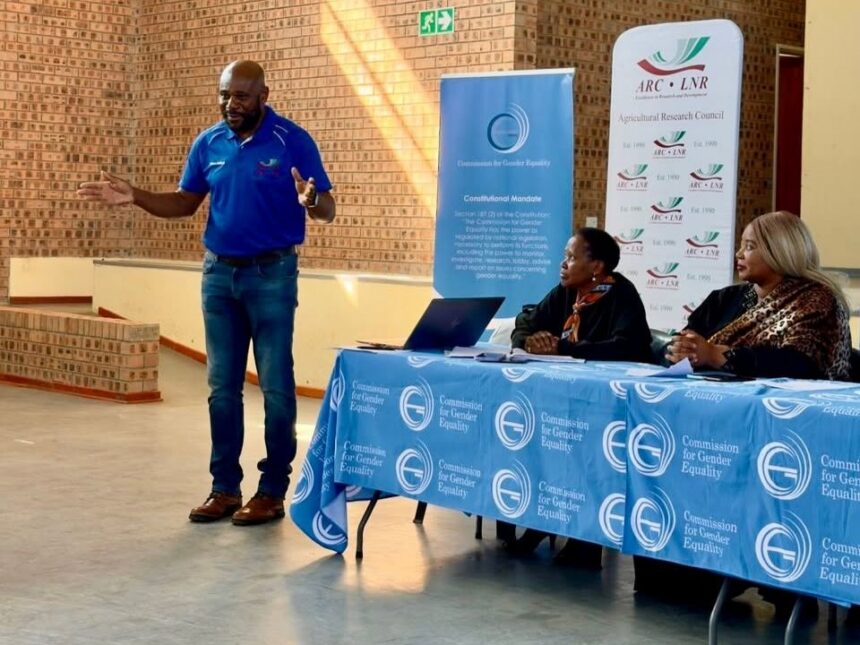
Women farmers continue to play a central role in food production and rural livelihoods across South Africa, yet many still face barriers that limit their access to resources, technology and markets. A recent stakeholder engagement held in Bushbuckridge brought these realities into focus through a collaborative effort led by the Agricultural Research Council alongside the Commission for Gender Equality. The gathering created a space where women farmers, researchers and development partners could meet on equal footing to discuss challenges and practical solutions. The focus remained on how research and innovation can directly support women-led agricultural enterprises in meaningful ways. The event highlighted the growing recognition that empowering women in agriculture strengthens entire communities and improves long-term food security.
The engagement brought together a diverse group of participants, including smallholder women farmers from surrounding rural areas, agricultural scientists and institutional stakeholders. Each group contributed different perspectives shaped by lived experience, technical knowledge and policy understanding. Women farmers shared firsthand accounts of the difficulties they face, including limited access to farming inputs, restricted market opportunities and insufficient infrastructure. Researchers responded by presenting evidence-based approaches that can help address these constraints through improved farming methods and targeted support systems. The dialogue created a balanced exchange where practical challenges were matched with research-driven ideas designed for real-world application.
A key focus of the discussions was the role of research in improving agricultural productivity for women-led farms. The Agricultural Research Council emphasized the importance of developing technologies that are accessible, affordable and adaptable to small-scale farming conditions. These include improved seed varieties, soil management techniques and water-efficient irrigation systems that can help farmers increase yields while reducing costs. Participants also explored how climate-smart agriculture can support resilience in areas affected by changing weather patterns and resource limitations. The engagement reinforced the idea that research must move beyond laboratories and directly reach farming communities to have a lasting impact.
The event also highlighted the importance of collaboration between government institutions, research bodies and local farming communities. The Commission for Gender Equality played a central role in facilitating discussions that focused on inclusion and equal access to agricultural opportunities. Stakeholders emphasized that women farmers often contribute significantly to household food production and local economies, yet they remain underrepresented in formal agricultural systems. By creating platforms for collaboration, institutions can help bridge these gaps and ensure that women are fully included in agricultural development programs. The discussions also pointed toward the need for stronger policy alignment to support women-led farming initiatives.
An important feature of the engagement was the exhibition showcasing agricultural technologies and support services designed to strengthen farming enterprises. These displays provided practical demonstrations of tools and innovations that can improve efficiency and productivity on small farms. Technologies included irrigation solutions, soil testing kits and mechanization tools adapted for smallholder use. Support services on display also offered information on training programs, funding opportunities and extension services available to farmers. For many attendees, the exhibition provided direct exposure to solutions that can be applied immediately within their own farming activities.
Women farmers who attended the exhibition had the opportunity to interact directly with researchers and service providers. These interactions allowed them to ask specific questions about their farming challenges and receive tailored advice. In many cases, farmers gained practical insights into improving crop yields, managing pests and optimizing resource use. The hands-on nature of these engagements made the event more impactful, as participants could connect theoretical research with everyday farming realities. This direct exchange strengthened trust between farmers and institutions and encouraged continued collaboration beyond the event.
The discussions also addressed broader issues affecting women in agriculture, including access to land, financial support and decision-making opportunities. Many participants emphasized that while technical solutions are important, structural barriers must also be addressed to create lasting change. Researchers and policymakers acknowledged that empowering women farmers requires a holistic approach that combines innovation with social and economic support systems. The engagement highlighted the need for continuous dialogue to ensure that policies remain responsive to the needs of rural communities. It also reinforced the importance of including women in every stage of agricultural planning and development.
Collaboration was identified as a key driver of progress, particularly when it involves multiple stakeholders working toward shared goals. The Agricultural Research Council stressed that partnerships with communities help ensure that research outputs are relevant and effective. By working closely with farmers, researchers can better understand real-world conditions and design solutions that are practical and scalable. The engagement demonstrated how knowledge sharing can lead to stronger agricultural systems that benefit both individual farmers and the wider economy. It also showed that inclusive development requires sustained cooperation rather than isolated interventions.
The stakeholder engagement in Bushbuckridge served as a powerful example of how research and collaboration can empower women farmers and strengthen agricultural development. By bringing together different voices and perspectives, the event created a platform for meaningful dialogue and actionable solutions. The combination of research insights, practical demonstrations and community engagement highlighted the potential for innovation to drive real change in rural farming systems. As South Africa continues to focus on inclusive agricultural growth, initiatives like this will remain essential in ensuring that women farmers are not only supported but fully integrated into the future of the sector.
Join 'Farmers Mag' WhatsApp Channel
Get the latest Farming news and tips delivered straight to your WhatsApp
CLICK HERE TO JOIN