The KwaZulu-Natal Department of Agriculture and Rural Development, working together with Sutherland Seedlings, hosted a Farmers’ Day and information sharing session focused on vegetable crop production in the Harry Gwala District. The event brought together local farmers, extension officers, and key agricultural stakeholders under the theme “Promoting Sustainable Vegetable Production and Food Security.” It was held in the Johnnes Phumlani Phungula Local Municipality on Thursday, 18 June 2026, and formed part of ongoing efforts to strengthen agricultural knowledge transfer in rural communities. The session aimed to improve production practices while also supporting food security and rural economic development. Farmers attending the event gained direct exposure to both technical systems and practical farming environments.
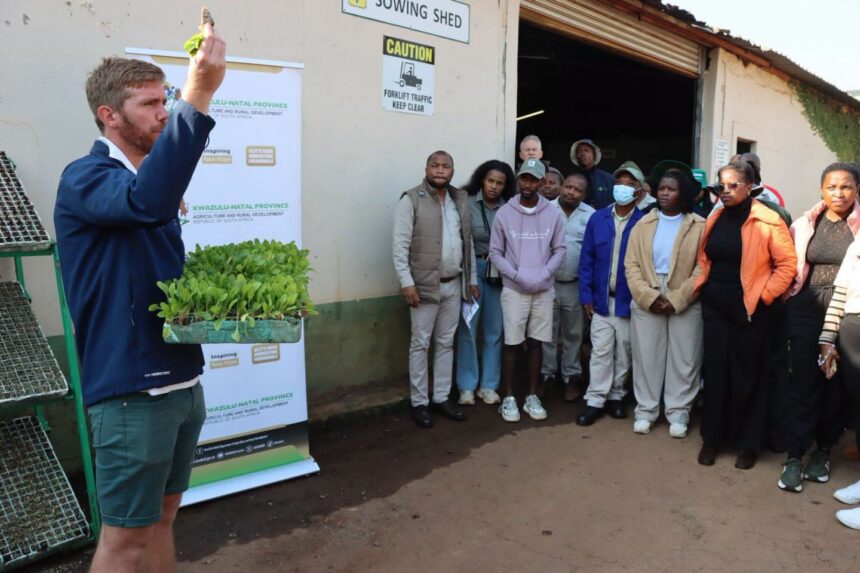
The programme began with a structured visit to Sutherland Seedlings, where participants were introduced to modern seedling production systems. Farmers observed how seedlings are produced in controlled environments designed to improve consistency, quality, and disease resistance. The visit included detailed explanations of grading processes used to assess plant health, structural strength, and uniform growth. These quality indicators are critical for ensuring that seedlings perform well once transplanted into open-field production systems. Farmers were able to see how early-stage plant management directly influences final crop yield and market quality.
After the facility tour, participants moved to Mbheleja Enterprises for a practical field walk that demonstrated real-world vegetable production techniques. Mbheleja Enterprises is an emerging smallholder farming business that focuses on vegetable production and contributes to local job creation and skills development. Farmers engaged directly with production experts from Sutherland Seedlings and observed how planting methods are applied in field conditions. The field demonstration provided insight into spacing techniques, irrigation practices, pest control approaches, and soil management strategies. This hands-on exposure allowed farmers to connect theory with practical application on an active farm.
The interaction at Mbheleja Enterprises created space for meaningful knowledge exchange between experienced practitioners and emerging farmers. Discussions focused on improving production efficiency and addressing challenges linked to climate variability, which continues to affect agricultural output in the district. Farmers learned about adaptive practices that help reduce crop losses during extreme weather conditions. The session also highlighted opportunities for improving market access through better quality control and consistent production cycles. These insights are particularly important for smallholder farmers who aim to scale their operations and enter formal markets.
Throughout the day, stakeholders engaged in detailed discussions on innovative farming methods and improved seedling production systems. Topics included fertilisation strategies, soil health management, irrigation efficiency, and integrated pest management practices. Participants also explored available departmental support programmes designed to assist emerging farmers with inputs, training, and market linkages. Agricultural partners present at the event included TWK Agri, the JPP LED Office, Farmers Agri-Care, KHULA, the Land Bank of South Africa, Kwanalu, and the Tshala Nathi Group. This broad participation highlighted the importance of coordinated support in strengthening agricultural development at local level.
A strong emphasis was placed on climate adaptation strategies, given the increasing pressure that changing weather patterns place on vegetable production. Farmers were encouraged to adopt practices that improve resilience, such as water-efficient irrigation systems and climate-smart crop selection. Extension officers provided guidance on how to reduce risk while maintaining productivity under unpredictable conditions. The discussions reinforced the need for continuous learning and adaptation in order to sustain long-term agricultural success. These approaches are essential for protecting both household food supply and commercial farming income.
During the session, KZN DARD Harry Gwala District Director Ms Smangele Zulu highlighted the importance of partnerships in building strong agricultural systems. She stressed that collaboration between government, private sector stakeholders, and farming communities is key to improving productivity and sustainability. According to her address, skills transfer and improved market access remain central to supporting emerging farmers in the district. She also emphasized that agricultural development depends on ensuring farmers have access to training, resources, and ongoing technical support. Her message reinforced the department’s commitment to inclusive rural development.
Ms Zulu further encouraged young farmers to actively participate in agricultural programmes and take advantage of available opportunities. She noted that youth involvement is critical for the long-term sustainability of the agricultural sector in KwaZulu-Natal. By engaging in training sessions, demonstrations, and support initiatives, young farmers can build stronger enterprises and improve their competitiveness. She emphasized that agriculture offers viable pathways for employment, entrepreneurship, and rural development. Her remarks underscored the importance of empowering the next generation of farmers.
The Farmers’ Day in Harry Gwala District demonstrated the value of practical training combined with expert guidance and institutional support. By bringing farmers into direct contact with production systems and experienced practitioners, the programme strengthened understanding of modern vegetable farming techniques. The collaboration between KZN DARD, Sutherland Seedlings, and multiple stakeholders created a strong platform for knowledge sharing and agricultural development. The event also reinforced the importance of partnerships in addressing food security and rural economic challenges. As farmers apply the lessons learned, the initiative is expected to contribute to stronger production systems, improved yields, and more sustainable farming enterprises across the district.
Join 'Farmers Mag' WhatsApp Channel
Get the latest Farming news and tips delivered straight to your WhatsApp
CLICK HERE TO JOIN