

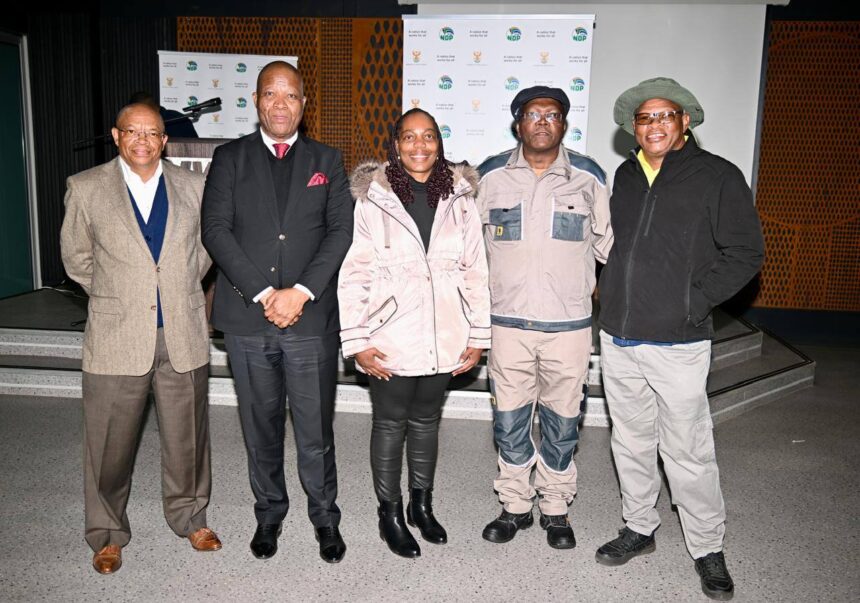
The Department of Cooperative Governance and Traditional Affairs continues to strengthen rural development and livestock productivity through targeted agricultural support programmes across South Africa. The Deputy Minister for the Department of Cooperative Governance and Traditional Affairs, Namane Dickson Masemola, together with the Head of Department, Hans Kekana, recently led an important livestock handover ceremony in Bodibe Village near Lichtenburg. The event saw the official handover of a Bonsmara bull to Kgosi Matlaba wa Barolong-boo-Rapulana, marking a significant step in strengthening rural farming capacity. The initiative forms part of government’s broader commitment to improving agricultural productivity within traditional communities. It also reflects a growing focus on practical interventions that directly support emerging livestock farmers and rural households.
The handover took place under the Kaonafatso ya Dikgomo programme, a livestock improvement initiative designed to enhance herd performance through structured and scientific farming methods. The programme focuses on improving genetic quality, productivity and profitability in cattle farming systems across rural areas. It promotes the use of animal recording systems that allow farmers to track breeding, growth rates and overall herd performance more effectively. Through this approach, farmers gain access to better decision making tools that support long term sustainability. The introduction of high quality breeding bulls like the Bonsmara is intended to improve herd genetics and increase livestock value over time.
The Bonsmara breed is widely recognised in South Africa for its strong adaptability, fertility and beef production efficiency. By introducing this breed into community herds, the programme aims to improve meat quality and overall herd resilience under varying environmental conditions. Farmers benefit from improved calving rates and better growth performance, which directly contributes to increased income generation. The use of scientifically selected breeding animals also helps reduce losses associated with poor genetics and low productivity. This approach ensures that livestock improvement is based on measurable outcomes rather than traditional practices alone.
The Kaonafatso ya Dikgomo programme also places strong emphasis on technology transfer and farmer education. Farmers are trained on modern livestock management techniques that include record keeping, breeding selection and herd health monitoring. These skills are essential for transforming livestock farming into a more structured and commercially viable activity. The programme also encourages collaboration between government veterinarians, extension officers and local communities to ensure continuous support. By improving access to knowledge and technical resources, the initiative strengthens the ability of rural farmers to compete in formal markets.
During the handover event, government officials highlighted the importance of empowering traditional leadership structures in agricultural development. Kgosi Matlaba wa Barolong-boo-Rapulana received the Bonsmara bull as part of efforts to strengthen communal farming systems in Bodibe Village. Traditional leaders play a key role in mobilising communities and ensuring that agricultural programmes are effectively implemented at local level. Their involvement helps build trust and encourages participation from emerging farmers. This partnership between government and traditional authorities is seen as essential for achieving sustainable rural development outcomes.
The initiative reflects a broader national commitment to improving food security through livestock development. Strengthening cattle production contributes directly to increased meat supply, improved rural incomes and enhanced economic stability in farming communities. Government support for emerging farmers is also aimed at reducing inequality in agricultural production systems. By providing access to quality breeding stock and technical support, the programme helps bridge the gap between subsistence and commercial farming. This contributes to long term resilience in the agricultural sector and supports national development goals.
The Kaonafatso ya Dikgomo programme continues to play a critical role in transforming rural livestock farming into a more productive and sustainable sector. Through initiatives such as the Bonsmara bull handover, government is actively investing in genetic improvement, skills development and community empowerment. The programme demonstrates how targeted agricultural interventions can create meaningful change in rural economies. It also reinforces the importance of combining traditional farming knowledge with modern scientific practices. As the initiative expands, it is expected to strengthen food security, improve livestock quality and support emerging farmers across South Africa in building more profitable and sustainable farming operations.
Join 'Farmers Mag' WhatsApp Channel
Get the latest Farming news and tips delivered straight to your WhatsApp
CLICK HERE TO JOIN




